Pediatric Liver Transplant: A Parent's Guide to a Life-Saving Procedure
.webp)
Principal Consultant & Unit Head, Liver Transplant & HPB Surgery, Fortis Hospital, Shalimar Bagh, Delhi
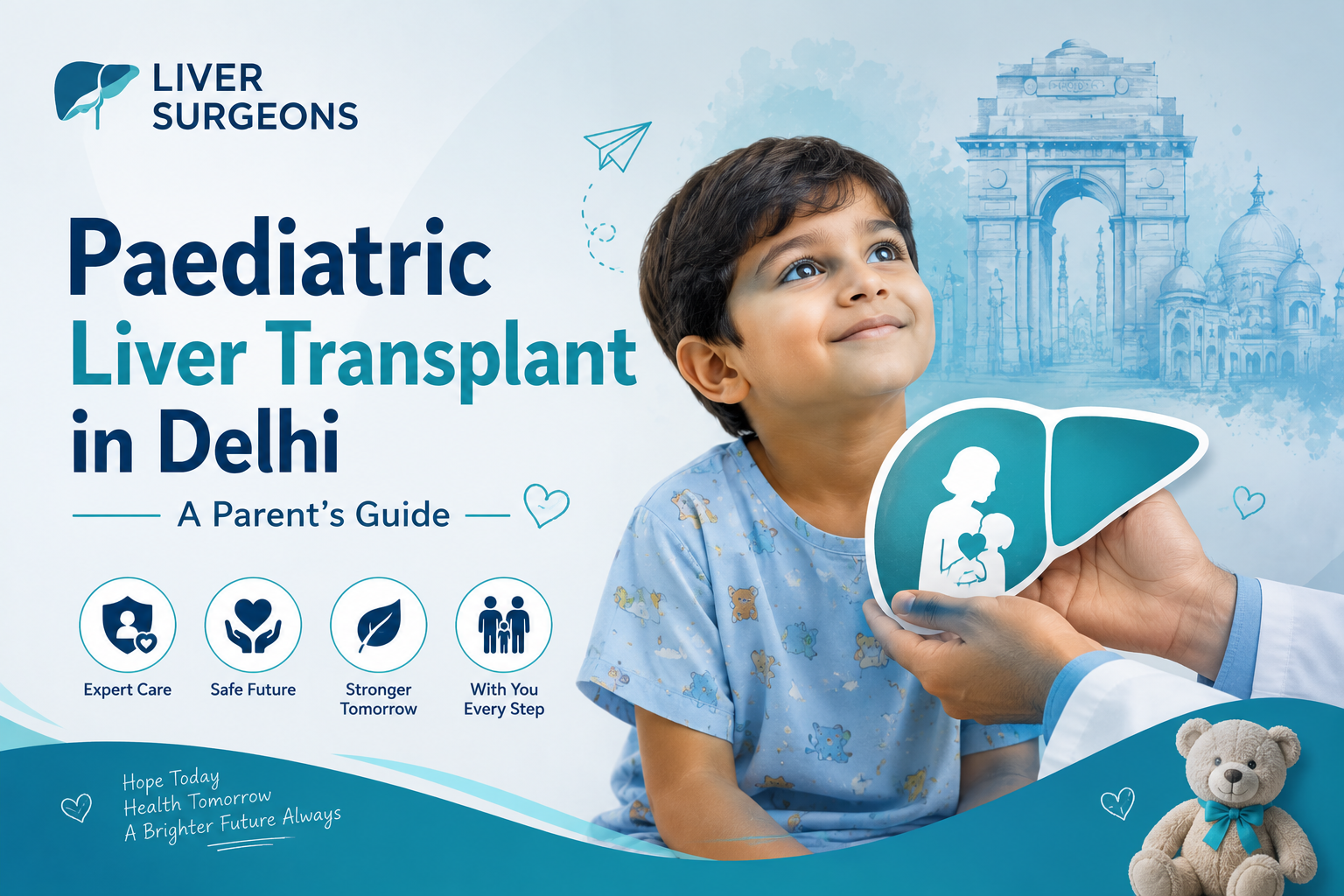
A pediatric liver transplant is a life-saving surgery where a child's failing liver is replaced with a healthy partial or whole liver from a donor. It is the definitive cure for end-stage liver disease, with survival rates in India now exceeding 90%.
As a surgeon, I meet parents at what feels like the most frightening intersection of their lives. You have just been told your child needs a liver transplant. The ground feels unsteady. You are drowning in medical terms like "PELD scores," "biliary atresia," and "immunosuppression."
But here is the truth I need you to know right now: This is not the end of the road. It is a new beginning.
In the last decade, the landscape of Pediatric Liver Transplants in Delhi has transformed. What was once a medical Hail Mary is now a standardized, highly successful procedure. I have watched infants who were too weak to cry grow into teenagers playing football and graduating high school.
This guide is written for you, the parent. It is not a medical textbook. It is a practical, honest, and comprehensive roadmap of what lies ahead, written from my perspective as a surgeon who walks this path with families every day.
1. The Diagnosis: Why Does My Child Need This?
Unlike adults, where liver failure is often lifestyle-related, liver failure in children is almost always something they were born with or acquired through no fault of their own.
The Common Culprits
- Biliary Atresia: This is the number one reason I perform transplants in children. It occurs when the bile ducts are blocked or absent, trapping bile in the liver and causing rapid scarring (cirrhosis). If a Kasai procedure fails, a transplant is the only option.
- Metabolic Disorders: Diseases like Wilson’s Disease or Urea Cycle Disorders fall into this category. In these cases, the liver might look normal on a scan, but it is missing a critical enzyme, turning the body’s chemistry against itself.
- Acute Liver Failure: This is a sudden crash in a previously healthy child, often due to viral infections (like Hepatitis A) or drug toxicity.
According to 2024-2025 registry data, Biliary Atresia accounts for nearly 50% of all pediatric liver transplants performed in India.
2. The Solution: Living Donor vs. Deceased Donor
This is the most critical decision you will face. In India, we have a unique challenge. The waiting list for deceased donor (cadaver) organs is long, and pediatric-sized organs are incredibly rare.
The "Split Liver" and Living Donor Revolution
Because we cannot wait for a child-sized organ to become available, we rely heavily on Living Donor Liver Transplant (LDLT). This is where a healthy relative (usually a parent) donates a portion of their liver to the child.
Contrarian Insight: Waiting for a deceased donor is often a gamble you shouldn't take.
With a living donor, we convert an emergency surgery into a planned, elective procedure. We operate before your child becomes critically ill.
Table 1: Comparing Donor Options
| Feature | Living Donor (LDLT) | Deceased Donor (DDLT) |
|---|---|---|
| Availability | Immediate (once a donor matches). | Unpredictable (months to years). |
| Organ Quality | Excellent (healthy, screened donor). | Variable. |
| Surgery Timing | Planned/Elective. | Emergency (often middle of the night). |
| Success Rate | 90-95% (1-Year Survival). | Slightly lower due to waitlist sickness. |
Did You Know? The liver is the only organ that regenerates. If you donate a piece of your liver to your child, your liver will grow back to its near-normal size within 6 to 8 weeks.
3. The Evaluation: Measuring Urgency with PELD
If you are listed for a deceased donor, your place in line is determined by the Pediatric End-Stage Liver Disease (PELD) score (for children under 12). It is not about "first come, first served" but rather "sickest first."
The PELD Score calculates risk using:
- Bilirubin: Measures jaundice.
- INR: Measures blood clotting (a key liver function).
- Albumin: Measures nutritional status.
- Growth Failure: Is the child not growing? (+0.667 points).
- Age < 1 Year: Infants get priority (+0.436 points).
Note: If you have a living donor, the PELD score is less relevant because we schedule the surgery based on your child's needs, not a list position.
4. The Cost of Saving a Life (2026 Outlook)
Let’s talk numbers. Financial anxiety is real, and I believe in transparency.
Estimated Costs in Delhi
As of 2024-2025, a complete Children Liver Transplant package in a high-volume private hospital in Delhi typically ranges from ₹15 Lakh to ₹25 Lakh ($18,000 to $30,000).
- Includes: Pre-op workup, surgery for donor and recipient, and initial ICU stay.
- Excludes: Post-discharge medications (approx. ₹10,000 to ₹15,000/month initially, reducing over time).
Financial Assistance
You do not have to bear this alone.
- Insurance: Most comprehensive health policies now cover transplants. Check your "Organ Donor" sub-limits.
- Government Schemes: Under Ayushman Bharat (PMJAY), eligible families can receive coverage up to ₹5 Lakhs. Some states like Maharashtra have expanded coverage up to ₹20 Lakhs for transplants.
- Crowdfunding: Platforms like ImpactGuru and Ketto, along with NGOs like the Children’s Organ Transplant Association (COTA) (US-based) or local trusts like the Transplants – Help the Poor Foundation, are vital. I have seen communities raise lakhs in days for a child.
5. Choosing Your Team: Why Expertise Matters
You are trusting a surgeon with your child's life. You need more than just a degree on the wall. When looking for the Best liver surgeon in india or the best liver surgeon in Delhi, look for volume.
Questions to Ask Your Surgeon:
- “How many pediatric transplants did you perform last year?” (Pediatric surgery requires different microsurgical skills than adult surgery).
- “What is your 1-year and 5-year survival rate for children?” (Look for >90%).
- “Do you have a dedicated pediatric ICU team?” (The surgery is 12 hours. The recovery is 2 weeks in ICU. The intensivist is as important as the surgeon).
6. The Surgery: Precision and Patience
The surgery is a marathon, often lasting 8 to 12 hours.
- For the Donor: We remove a segment of the liver (usually the left lateral segment for small children) using minimally invasive techniques to ensure a quick recovery.
- For the Child: We carefully remove the diseased liver and implant the new one. The blood vessels in children are tiny. They are often smaller than a pen refill. This requires microsurgical precision.
Why the Surgery is Actually the "Easy" Part
This sounds contrarian, I know. But as a surgeon, the operation is a controlled event. I can fix the anatomy. The real challenge, and where your role as a parent is crucial, is the post-operative adherence.
7. Life After Transplant: The New Normal
Your child will not just survive. They will thrive. Most of my patients return to school within 3 to 6 months. They play sports, travel, and eventually get married and have children of their own.
However, there are three non-negotiable rules for the rest of their life:
1. Immunosuppression is Life
Your child will take anti-rejection medication (like Tacrolimus) every day.
- The Golden Rule: Never miss a dose.
- The Diet Trap: Avoid Grapefruit, Pomegranates, and Seville Oranges. These fruits interfere with how the liver processes the medicine, leading to toxic overdose levels.
2. Infection Prevention
For the first 3 to 6 months, your child is "immunocompromised."
- Hand hygiene is your new religion.
- Avoid crowds and raw foods (no street food, no sushi, no half-boiled eggs).
- Vaccines: No "live" vaccines (MMR, Chickenpox, Rotavirus) after transplant. Ensure all vaccines are up to date before surgery.
3. Annual Checkups
Even if they feel perfect, they need regular blood tests. Rejection can be silent.
Final Words: A Decision of Love
A liver transplant is a massive undertaking. It is expensive, emotionally draining, and medically complex. But the alternative, watching a child fade away, is unacceptable when a cure exists.
Science has done the heavy lifting. The survival rates are in your favor. With the right team and your dedication, your child has a long, beautiful life ahead.
Which Path is Right for You in 2026?
If your child is suffering from liver failure, time is the most valuable currency you have. Do not wait for the PELD score to spike.
Contact Dr. Ashish George at LiverSurgeons today. Let’s evaluate your options and plan for a future where your child isn't just surviving, but growing