Portal Hypertension in Children: Causes, Warning Signs and Treatment
.webp)
Principal Consultant & Unit Head, Liver Transplant & HPB Surgery, Fortis Hospital, Shalimar Bagh, Delhi
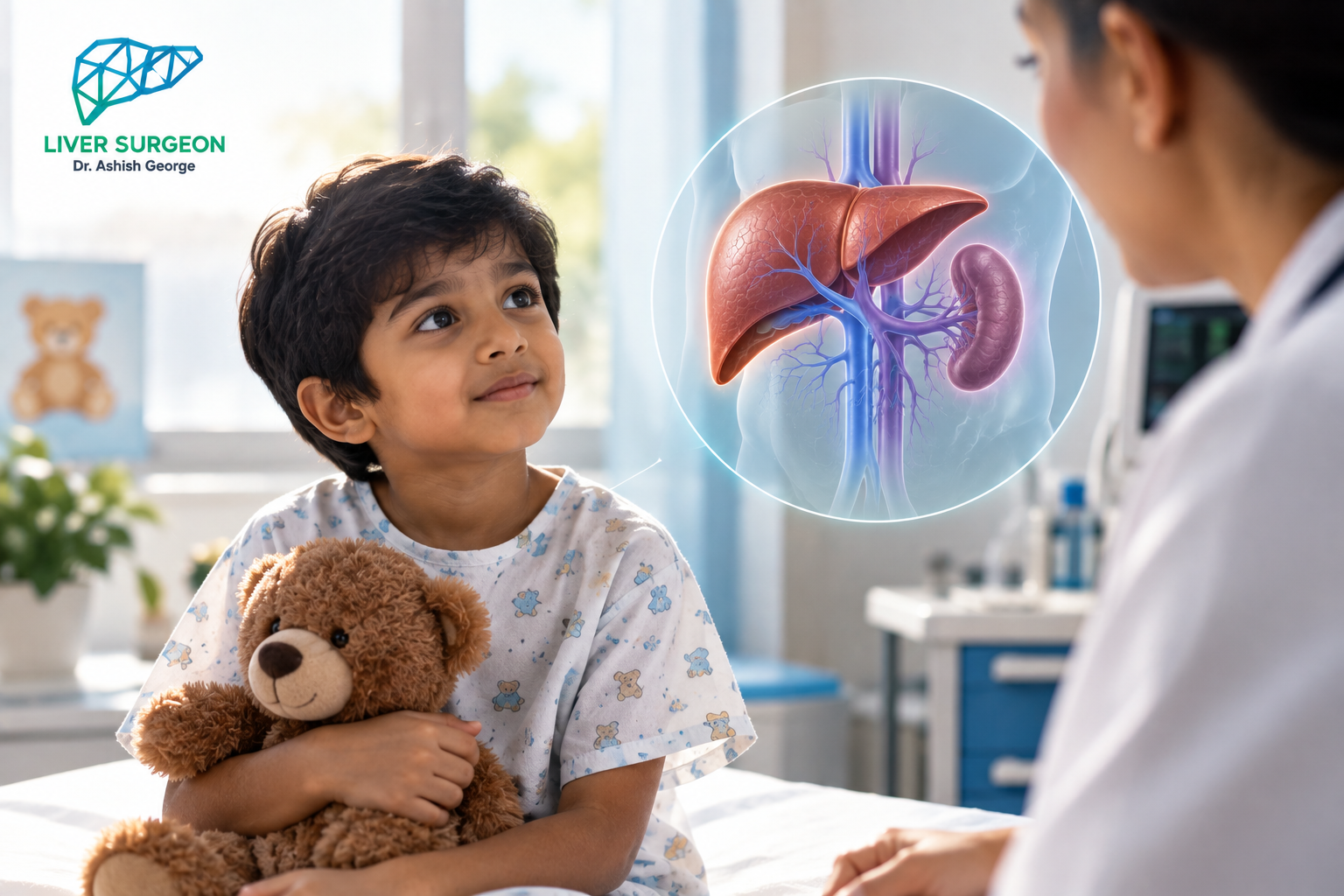
When a child suddenly vomits blood or is found to have a very large spleen, portal hypertension is often the cause. The good news is that in children it is frequently very treatable.
Portal hypertension means high pressure in the portal vein, the large vein that carries blood from the intestines and spleen to the liver. Portal hypertension in children is different from the adult form in an important way: in many children the liver itself is healthy, and the problem is a blocked portal vein rather than liver disease. This matters because it often means the condition can be treated very effectively, sometimes with a near-complete cure. This guide explains what causes portal hypertension in children, the warning signs every parent should know, how it is diagnosed, and the treatment options.
What Is Portal Hypertension in Children?
The portal vein carries blood to the liver. When blood flow through it is blocked or resisted, pressure builds up behind the blockage. This high pressure forces blood into smaller veins that are not meant to carry it, especially around the food pipe and stomach, where they swell into fragile varices that can bleed. The spleen also enlarges as blood backs up into it. In children, the most common cause is a blocked portal vein rather than a damaged liver.
What Causes Portal Hypertension in Children?
The causes fall into two groups, depending on whether the liver is healthy or diseased.
| Cause | What Happens | Liver Itself |
|---|---|---|
| EHPVO (extrahepatic portal vein obstruction) | The portal vein is blocked outside the liver; the most common cause in Indian children | Usually healthy |
| Cirrhosis | Scarring of the liver raises pressure | Diseased |
| Biliary atresia (after Kasai) | Bile duct disease leading to liver scarring | Diseased |
| Congenital hepatic fibrosis | An inherited condition causing liver fibrosis | Diseased |
| Budd-Chiari and others | Blocked veins draining the liver | Varies |
The most important of these is EHPVO, where the portal vein is blocked outside the liver and the liver itself is usually normal. EHPVO is the leading cause of portal hypertension in children in India, and it is also the one with the most rewarding treatment, because restoring blood flow can effectively cure the problem. The definitive treatment for it is the Rex shunt (meso-Rex bypass).
Warning Signs Parents Should Know
Portal hypertension in children often stays silent until it announces itself suddenly. The key warning signs are:
- Vomiting blood or black, tarry stools: the most alarming and most common first sign, caused by bleeding varices; this is a medical emergency
- An enlarged spleen: often the first thing a doctor or parent notices, felt as a firm swelling on the left side of the tummy
- Low blood counts: a large spleen traps platelets and white cells, so blood tests may show low counts (hypersplenism)
- Poor growth or a swollen tummy: in some children, slower growth or fluid in the abdomen
If a child vomits blood, go to an emergency department immediately. A first bleed is frightening but very treatable, and it is often the event that leads to the diagnosis.
How Is It Diagnosed?
- Ultrasound with Doppler: the key first test, showing the blocked portal vein and the enlarged spleen
- Endoscopy: looks directly at the varices in the food pipe and stomach
- CT or MRI angiography: maps the veins in detail, essential for planning surgery such as a Rex shunt
- Blood tests: check blood counts and liver function
Treatment Options for Portal Hypertension in Children
Treatment has two goals: stop and prevent bleeding, and where possible, correct the underlying pressure problem.
| Treatment | What It Does | Role |
|---|---|---|
| Endoscopic therapy (banding/sclerotherapy) | Controls and prevents variceal bleeding | First-line for bleeding; controls symptoms but does not cure the pressure |
| Medicines | Lower the pressure or slow bleeding | Supportive |
| Rex shunt (meso-Rex bypass) | Restores normal blood flow to the liver in EHPVO | The definitive, potentially curative surgery for suitable EHPVO children |
| Other shunts (e.g. splenorenal) | Divert blood to lower the pressure | Used when a Rex shunt is not possible |
| Liver transplant | Replaces a diseased liver | For portal hypertension caused by advanced liver disease, not EHPVO |
For children with EHPVO, endoscopy controls the bleeding, but the Rex shunt is the operation that can actually correct the problem by restoring blood flow to the liver. Where portal hypertension is due to liver disease, management may involve liver transplant evaluation. The right path depends entirely on the cause, which is why specialist assessment matters.
Why Specialist Care Matters
Portal hypertension in children is uncommon and needs a team experienced in paediatric hepatobiliary surgery. The difference between simply controlling bleeding for years and actually correcting the problem often comes down to whether the child is assessed by a centre that can offer the full range of options, including the Rex shunt. Early referral to a specialist can change a child's entire future, restoring normal growth and reducing the lifelong risk of bleeding.
Portal Hypertension Care for Children in Delhi
At Liver Surgeons, Dr. Ashish George manages portal hypertension in children at Fortis Hospital, Shalimar Bagh, Delhi, as part of a dedicated portal hypertension surgery programme. This includes endoscopic management of bleeding, Rex shunt and other shunt surgery, and liver transplant where needed, with every child assessed to find the treatment that offers the best long-term outcome. For families outside Delhi, scans and reports can be reviewed remotely before travel.
Frequently Asked Questions
What is the most common cause of portal hypertension in children in India?
EHPVO, a blockage of the portal vein outside the liver, is the most common cause. In these children the liver itself is usually healthy, which is why treatment can be so effective.
What are the first signs of portal hypertension in a child?
The most common first signs are vomiting blood or black stools (from bleeding varices) and an enlarged spleen. Low platelet counts on a blood test are also common. Blood vomiting is an emergency and needs immediate care.
Can portal hypertension in children be cured?
When it is caused by EHPVO and the anatomy is suitable, a Rex shunt can restore normal blood flow to the liver and effectively correct the problem, which is as close to a cure as this condition offers. When it is caused by liver disease, treatment focuses on managing the disease.
Is blood vomiting in a child always serious?
Yes, vomiting blood always needs emergency assessment. In a child with portal hypertension it usually means a variceal bleed, which is treatable but must be managed urgently.
Does an enlarged spleen in a child always mean portal hypertension?
No, there are other causes of an enlarged spleen, but in a child it should always be investigated, and portal hypertension is one important cause to rule out with an ultrasound.
Conclusion
Portal hypertension in children can be frightening, especially when it shows up as sudden bleeding, but it is often very treatable, and when it is caused by EHPVO it can frequently be corrected. The key is early specialist assessment to find the cause and the right treatment. If your child has had a bleed, has an enlarged spleen, or has been diagnosed with portal hypertension, book a consultation with Dr. Ashish George at Fortis Hospital, Shalimar Bagh, Delhi.