Why Bile Duct Repairs Fail and How Redo Surgery Fixes Them

Principal Consultant & Unit Head, Liver Transplant & HPB Surgery, Fortis Hospital, Shalimar Bagh, Delhi
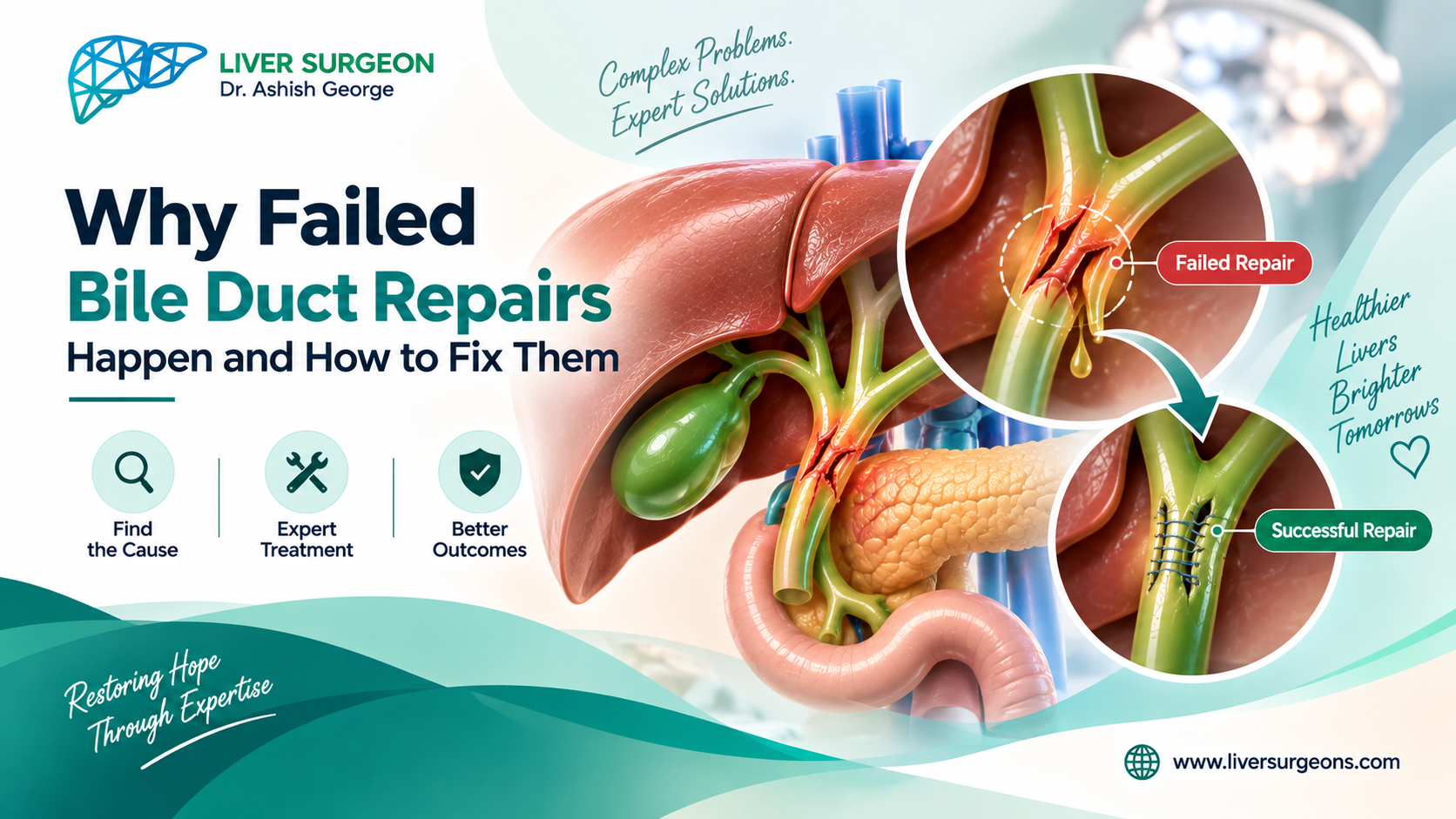
If your bile duct repair has narrowed again or stopped working, it is not the end of the road. Specialist redo surgery can fix most failed repairs and protect your liver.
A failed bile duct repair is one of the most disheartening situations in surgery for a patient. You went through an operation to fix a bile duct problem, and now the symptoms are back: jaundice, infections, or abnormal liver tests. The important and reassuring truth is that most failed repairs can be fixed with specialist redo surgery, and doing so protects the liver from long-term damage. This guide explains why bile duct repairs fail, how to recognise it, and how an experienced HPB centre puts it right.
How Do You Know a Bile Duct Repair Has Failed?
A repair that has narrowed again, known as a recurrent stricture, usually announces itself through these signs, sometimes months or years later:
- Returning jaundice: Yellowing of the eyes or skin.
- Repeated episodes of cholangitis: Fever with chills, often with pain, from infection in the blocked bile system.
- Abnormal liver blood tests: Rising bilirubin or liver enzymes.
- Itching, dark urine, or pale stools.
Important: If you have had a bile duct repair and these symptoms return, it suggests the repair has narrowed and needs specialist review.
Why Do Bile Duct Repairs Fail?
Most failed repairs come down to a few recognised reasons, and understanding them explains why specialist redo surgery can succeed where the first attempt did not.
| Reason | What Went Wrong |
|---|---|
| Repair by a non-specialist | The original repair was done by a general surgeon rather than an HPB specialist, the single most common reason. |
| Wrong timing | The repair was rushed into inflamed or infected tissue instead of being planned. |
| Wrong technique | A simple duct-to-duct repair was used where a Roux-en-Y hepaticojejunostomy was needed. |
| Tension or poor blood supply | The join was under tension or the duct ends had poor blood supply, so it scarred and narrowed. |
| High or complex injury | Injuries near the liver, known as high strictures, are technically harder and need specialist techniques. |
The common thread is that complex bile duct repair is a specialist operation. Done correctly the first time by an experienced HPB surgeon, long-term success is high. When the first attempt was not ideal, a specialist redo can still achieve a lasting result.
Can a Failed Bile Duct Repair Be Fixed?
Yes. This is the key message: most failed bile duct repairs can be successfully fixed with specialist redo surgery. A re-narrowed repair is reconstructed, usually with a carefully done Roux-en-Y hepaticojejunostomy at the right level, by a surgeon experienced in complex and redo biliary surgery. Even repairs that have failed more than once can often be salvaged at a specialist centre. The sooner it is addressed, the better, because repeated blockage and infection can slowly damage the liver over time.
What Does Redo Bile Duct Surgery Involve?
- Detailed imaging: MRCP and other scans map exactly where and why the repair narrowed.
- Settling infection first: Any cholangitis is controlled before surgery.
- Reconstruction: The scarred join is taken down and a fresh, tension-free hepaticojejunostomy is created at healthy duct.
- Sometimes a staged approach: In complex cases, drainage is performed first, followed by definitive repair.
Redo surgery is more demanding than a first repair because of scar tissue, which is exactly why it belongs at a high-volume HPB centre. See how these procedures are performed on our bile duct injury and reconstruction page .
What Happens If a Failed Repair Is Left Untreated?
A repair that has narrowed should not be ignored, even if symptoms come and go. Repeated bile blockage and infection cause slow, progressive liver damage that can eventually lead to secondary biliary cirrhosis and, in the worst cases, the need for a liver transplant . Timely redo surgery prevents this. Acting early protects the liver.
Why a Specialist Centre Matters Even More for Redo Surgery
If the first repair matters, the redo matters even more. Redo biliary surgery is among the most technically demanding operations in HPB practice, working through scar tissue to rebuild a durable join high in the bile duct. Success depends heavily on the surgeon's experience with complex and redo reconstruction. Choosing a high-volume HPB centre for a redo is the best way to make it the last operation you need.
Redo Bile Duct Surgery in Delhi
At Liver Surgeons, Dr. Ashish George performs complex and redo bile duct reconstruction at Fortis Hospital, Shalimar Bagh, Delhi, for patients whose first repair has failed or re-narrowed.
Every case is reassessed from scratch with fresh imaging before a tailored redo plan, with the aim of a durable, lasting repair. If your bile duct repair has failed, or your symptoms have returned, a specialist second opinion is worthwhile. Scans and records can be reviewed remotely for patients outside Delhi.
If you are newly facing a bile duct injury, start with our guide on what to do after a bile duct injury during gallbladder surgery .
Frequently Asked Questions
Why did my bile duct repair fail?
The most common reasons are that the first repair was done by a non-specialist, at the wrong time into inflamed tissue, or with the wrong technique. High or complex injuries and joins under tension also fail more often. A specialist redo addresses these.
What are the signs that a bile duct repair has failed?
Returning jaundice, repeated episodes of fever with chills, known as cholangitis, abnormal liver blood tests, itching, dark urine, or pale stools after an earlier repair all suggest the repair has narrowed and needs review.
Can a failed bile duct repair be fixed?
Yes. Most failed repairs can be fixed with specialist redo surgery, usually a carefully constructed Roux-en-Y hepaticojejunostomy. Even repairs that failed more than once can often be salvaged at an experienced HPB centre.
Is redo bile duct surgery riskier than the first repair?
Redo surgery is more technically demanding because of scar tissue, which is exactly why it should be done at a high-volume HPB centre. In experienced hands it has a high chance of a durable, lasting result.
What happens if I leave a failed repair untreated?
Repeated blockage and infection slowly damage the liver and can eventually cause secondary biliary cirrhosis, sometimes needing a transplant. Timely redo surgery prevents this, so it should not be left untreated.
Conclusion
A failed bile duct repair is not the end of the road. Most can be fixed with specialist redo surgery, and doing so protects your liver from long-term harm. The key is to recognise the signs early and get to an experienced HPB centre that does complex and redo biliary reconstruction.
If your repair has failed or your symptoms have returned, book a specialist consultation with Dr. Ashish George at Fortis Hospital, Shalimar Bagh, Delhi .