Liver Donor Evaluation Cost in Delhi: Tests, Price and What the Package Includes

Principal Consultant & Unit Head, Liver Transplant & HPB Surgery, Fortis Hospital, Shalimar Bagh, Delhi

When a family member offers to donate part of the liver, the first concern is usually safety. The next practical question is cost.
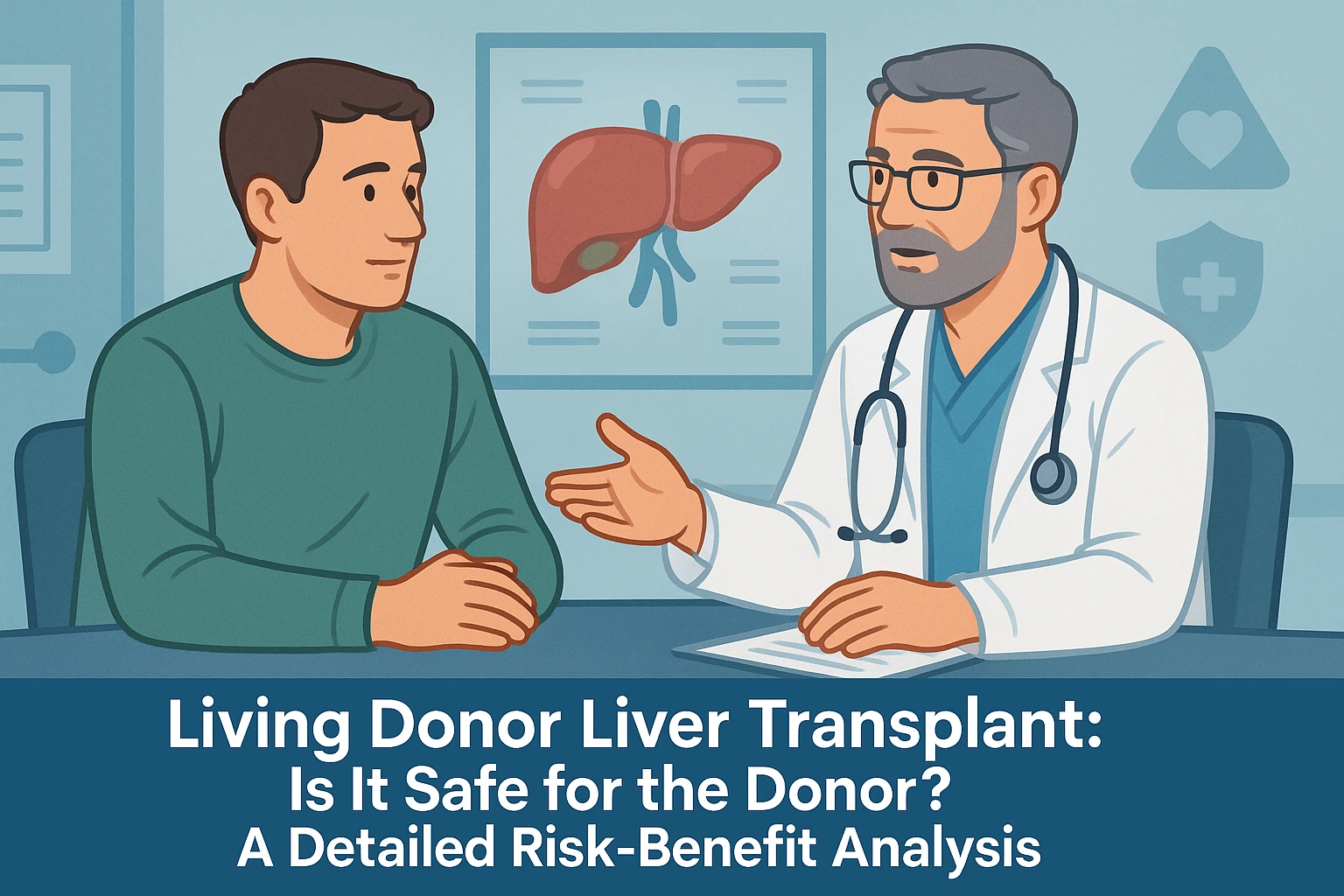
A living liver donor cannot be approved through one blood test or scan. The donor must complete a structured evaluation that checks general health, blood-group compatibility, liver quality, liver size, blood vessels, bile ducts, heart and lung fitness, emotional readiness and voluntary consent.
Because the workup happens in stages, the amount paid can vary. Some potential donors are ruled out after basic tests, while others proceed to advanced imaging and multiple specialist reviews.
This guide explains the expected liver donor evaluation cost in Delhi, what each phase includes, why some workups cost more and what families should ask before paying.
Quick Cost Answer
At private liver transplant centres in Delhi NCR, families can use the following indicative planning figures:
| Donor evaluation component | Indicative planning range |
|---|---|
| Initial consultation and basic screening | ₹5,000 to ₹20,000 |
| Blood group, routine blood tests and infection screening | ₹10,000 to ₹30,000 |
| Liver imaging, CT angiography and volumetry | ₹20,000 to ₹50,000 |
| MRCP or additional bile duct imaging | ₹10,000 to ₹30,000 |
| Heart, lung and specialist fitness assessment | ₹15,000 to ₹40,000 |
| Psychological, nutrition and independent donor assessment | Varies by centre |
| Additional tests or liver biopsy when required | ₹15,000 to ₹50,000 or more |
| Typical complete private donor evaluation | Approximately ₹80,000 to ₹1,50,000 |
| Complex evaluation with additional testing | May approach ₹2,00,000 |
These figures are planning estimates, not a fixed quotation. Charges vary with the hospital, test sequence, donor age, health history and need for additional investigations.
The existing LiverSurgeons.com cost page publishes a broader pre-transplant evaluation range of ₹50,000 to ₹1,50,000 but does not separate recipient and donor evaluation. The transplant billing team should confirm the donor-only range before this article is published.
Review the complete liver transplant cost in Delhi.
Why Is Donor Evaluation Necessary?
Living liver donation is major surgery performed on a healthy person for another patient’s benefit. The evaluation must protect the donor first.
The transplant team needs to confirm that:
- Donation is medically and surgically safe for the donor
- The donor is participating voluntarily
- Blood-group and transplant compatibility are acceptable
- The liver does not have unacceptable fat, fibrosis or disease
- The remaining liver volume will be safe for the donor
- The donated portion will be adequate for the recipient
- Liver arteries, veins and bile ducts can be safely divided and reconstructed
- The donor can tolerate anaesthesia and surgery
- There is no important infection or transmissible illness
- Psychological and social concerns have been addressed
- Required legal approvals and documentation are complete
NOTTO’s transplant manual describes living donor evaluation as an exhaustive process involving laboratory testing, liver imaging and expert consultation.
How Is the Evaluation Performed?
Many transplant programmes use a phased approach. Basic and less expensive tests come first. Advanced and more expensive tests are performed only when the early results are acceptable.
This sequencing protects the donor and helps families avoid unnecessary expenses when a basic incompatibility or medical issue is identified early.
Phase 1: Initial Compatibility and Health Screening
The first phase commonly includes:
- Medical and family history
- Physical examination
- Blood group testing
- Complete blood count
- Liver and kidney function tests
- Blood sugar and lipid profile
- Coagulation tests
- Urine tests
- Infection screening
- Initial ultrasound or assessment for fatty liver
- Review of medicines, supplements, alcohol and smoking
- Discussion of willingness and family pressure
If an important concern appears, the team may pause the evaluation and recommend treatment, weight reduction or evaluation of a different donor.
Phase 2: Liver Anatomy and Volume
A donor who passes the initial screening usually proceeds to detailed liver imaging.
CT angiography and liver volumetry help the surgical team assess:
- Total liver volume
- The amount of liver that would remain with the donor
- The size of the graft available for the recipient
- Hepatic artery anatomy
- Portal vein anatomy
- Hepatic vein anatomy
- Surgical complexity
MRCP or another form of biliary imaging may be used to study the bile ducts. Anatomical variations do not always exclude donation, but they can affect surgical planning and risk.
Phase 3: Whole-Body Fitness Assessment
A potential donor may undergo:
- ECG
- Echocardiography
- Chest imaging
- Pulmonary function testing
- Cardiology review
- Pulmonology review
- Anaesthesia assessment
- Age and sex-appropriate cancer screening
- Additional endocrine or metabolic testing
- Gynaecological assessment when clinically required
Tests are based on the individual donor’s age, medical history and initial results. Every person does not need every possible investigation.
Phase 4: Psychological, Social and Legal Assessment
Living donation must be informed and voluntary.
The process may include:
- Psychological or psychiatric assessment
- Independent donor counselling
- Confirmation that there is no payment or coercion
- Explanation of surgical risks and recovery
- Verification of relationship documents
- Consent forms
- Authorisation committee review where required
- Interview and legal documentation under applicable transplant law
This part of the evaluation is as important as blood tests and imaging.
What Can Increase the Donor Evaluation Cost?
The final bill may be higher when:
- CT or MRI imaging must be repeated
- The donor has possible fatty liver
- A FibroScan or specialised liver test is required
- A liver biopsy is advised
- Cardiac stress testing or angiography is needed
- Additional specialists must provide clearance
- An infection or abnormal result needs investigation
- Blood-group incompatibility requires a different treatment pathway
- Documents require additional legal processing
- Testing was previously performed elsewhere but cannot be used
- The donor changes and a second person begins evaluation
Ask the transplant coordinator which previous reports can be accepted before repeating tests.
Is Donor Evaluation Included in the Liver Transplant Package?
Sometimes, but not always.
A hospital may quote:
- One combined package for recipient evaluation, donor evaluation and transplant surgery
- A separate donor-workup price
- Phase-wise charges paid as testing progresses
- A surgery package that starts only after the donor is approved
Families should ask for written clarification.
Important questions include:
- Is donor evaluation included in the transplant estimate?
- Which tests are included?
- Are CT volumetry and MRCP included?
- Are specialist consultations included?
- Is a liver biopsy included if required?
- What happens if the donor is rejected?
- Are repeat tests charged separately?
- Is another donor’s evaluation charged from the beginning?
- Are legal and authorisation committee charges included?
- Is donor surgery included in the final transplant package?
Donor Evaluation Cost Is Not Donor Surgery Cost
These are separate financial components.
Donor evaluation pays for testing and specialist assessment before approval.
Donor surgery cost includes the operation, anaesthesia, operating theatre, ICU or high-dependency care, ward stay, medicines, tests and follow-up relating to donor hepatectomy.
The main cost page currently lists living donor surgery at approximately ₹3 lakh to ₹6 lakh as one component of the total transplant cost. Families must confirm whether this is already included in the complete liver transplant cost in Delhi.
Who Can Be Evaluated as a Living Liver Donor?
A potential donor is generally expected to be:
- A legally eligible adult
- In good physical and mental health
- Able to provide informed and voluntary consent
- Free from unacceptable liver disease
- Free from medical conditions that create excessive surgical risk
- Suitable in blood group or approved for an alternative compatible pathway
- Anatomically suitable after liver imaging
- Able to retain a safe liver volume after donation
- Able to provide the required legal and relationship documents
Exact age, weight and medical criteria vary by programme and individual circumstances. Online checklists cannot approve a donor.
Read the complete living liver donor eligibility checklist.
How Long Does Donor Evaluation Take?
A straightforward workup may be completed over several days, but no fixed timeline can be promised.
The process can take longer when:
- An abnormal test needs to be repeated
- Fatty liver requires treatment or weight reduction
- Additional cardiac or respiratory assessment is needed
- Imaging needs expert review
- Relationship documents are incomplete
- Authorisation committee review is required
- The donor needs time for independent decision-making
ORGAN India describes liver donor evaluation as a phased outpatient process that commonly takes about 7 to 10 days, but actual timelines differ by hospital and case.
What Happens If the Donor Is Not Approved?
A donor may be declined because donation would create an unacceptable risk to the donor or an unsuitable graft for the recipient.
Possible reasons include:
- Significant fatty liver
- Diabetes or poorly controlled metabolic disease
- Heart or lung disease
- Infection
- Unfavourable liver volume
- Complex blood vessel or bile duct anatomy
- Important psychological concern
- Incomplete voluntary consent
- Legal or relationship documentation issues
- Size mismatch between donor and recipient
Rejection is a safety decision, not a failure by the donor.
Depending on the reason, the transplant team may:
- Recommend weight reduction and reassessment
- Treat a temporary medical problem
- Evaluate another family member
- Consider paired or swap pathways where legally and clinically appropriate
- Discuss a deceased donor waitlist pathway
- Review the case at another qualified centre
Read about options after a liver donor is rejected.
Does Insurance Cover Donor Evaluation?
Coverage varies substantially.
Some health insurance policies cover living donor expenses as part of the recipient’s transplant claim. Others may cover donor surgery but limit pre-transplant tests, or require pre-authorisation before the donor workup begins.
Ask the insurer:
- Is donor evaluation covered?
- Is there a separate donor-expense limit?
- Must testing be performed at a network hospital?
- Is CT volumetry or MRCP covered?
- Is donor surgery covered?
- Are rejected-donor evaluation costs covered?
- Which documents are required?
- Is cashless approval available?
Do not rely on a verbal statement. Request written confirmation.
Read the insurance pre-authorisation for liver transplant guide.
Can Government Schemes Cover Donor Evaluation?
Some government or employee schemes may include donor and recipient evaluation within a transplant package, subject to eligibility, empanelment and approval.
Published CGHS documentation has included ₹2.5 lakh for donor and recipient pre-transplant evaluation within its living donor liver transplant ceiling. This is a scheme ceiling and not the price of an individual donor workup.
The patient must confirm current rules with the scheme and hospital before testing begins.
How Can Families Avoid Unnecessary Donor Evaluation Costs?
- Begin with blood group and basic screening
- Tell the team about diabetes, obesity, medicines and previous illness
- Share all previous reports before repeating tests
- Follow the centre’s phased sequence
- Do not book advanced imaging independently without instructions
- Ask whether tests are included in the transplant package
- Start insurance pre-authorisation early
- Keep digital and printed copies of every report
- Ask for a written estimate with exclusions
- Do not evaluate several donors simultaneously unless the team advises it
The lowest-priced test bundle is not always the best value. Imaging must meet transplant-planning standards and be interpreted by the transplant team.
How to Start a Living Donor Evaluation in Delhi
For evaluation with the liver transplant team at Fortis Hospital, Shalimar Bagh:
- Collect the recipient’s latest medical summary and reports.
- Identify the potential donor and confirm voluntary interest.
- Arrange a consultation with the transplant team.
- Begin blood group and basic health screening.
- Proceed to advanced imaging only when advised.
- Obtain a written estimate for the remaining phases.
- Start insurance or scheme pre-authorisation.
- Complete medical, psychological and legal review.
- Receive the multidisciplinary team’s final decision.
Learn how the complete living donor liver transplant in Delhi pathway works.
Need a Personalised Liver Donor Evaluation Estimate in Delhi?
Contact Dr Ashish George’s liver transplant team at Fortis Hospital, Shalimar Bagh, for:
- Review of recipient and potential donor reports
- Phased donor evaluation planning
- Written estimate with test inclusions
- CT volumetry and liver anatomy assessment
- Insurance and TPA documentation support
- Guidance after a donor is declined
- Living donor transplant second opinion
Frequently Asked Questions
How much does liver donor evaluation cost in Delhi?
A complete private living liver donor evaluation is commonly planned at approximately ₹80,000 to ₹1,50,000. The amount may approach ₹2 lakh if additional imaging, a biopsy, cardiac testing or more specialist reviews are required. Obtain a patient-specific written estimate.
What tests are included in liver donor evaluation?
The workup may include blood group, blood and urine tests, infection screening, liver tests, ultrasound, CT angiography and volumetry, MRCP, heart and lung assessment, psychological review and legal documentation. The exact list is personalised.
Is donor evaluation included in liver transplant cost?
It may be included in a complete transplant package or billed separately. Ask whether advanced imaging, specialist consultations, repeat tests and the evaluation of a second donor are covered.
Do I lose the evaluation money if the donor is rejected?
Hospitals generally charge for tests and consultations already performed. Refund rules and package terms vary. Ask for the policy in writing before beginning advanced testing.
How long does liver donor evaluation take?
A straightforward evaluation may take several days. Additional medical testing, treatment of fatty liver or legal approval can extend the process.
Can a donor with fatty liver donate?
It depends on the amount of fat and overall donor safety. Some potential donors may improve liver fat through supervised weight loss and be reassessed, while others may not be suitable. The transplant team must decide.
Does health insurance cover donor tests?
Some policies cover donor expenses, while others impose limits or exclude parts of the evaluation. Pre-authorisation and written confirmation are important.
Can two family members be evaluated?
Yes, but the team may recommend sequential screening to reduce unnecessary cost. Start with basic compatibility and health checks before advanced imaging.
What is CT liver volumetry?
CT liver volumetry measures total liver size and estimates how much liver would remain with the donor and how much would be available for the recipient. It also maps important blood vessels for surgical planning.
Is donor evaluation safe?
Most evaluation tests are non-invasive or minimally invasive. CT uses radiation and contrast, and biopsy has specific risks when required. The team should explain the purpose and risks before each test.
Conclusion
Living liver donor evaluation is not an administrative formality. It is a detailed safety process designed to protect a healthy donor and confirm that the planned graft is suitable for the recipient.
In Delhi, a private donor workup can be planned at approximately ₹80,000 to ₹1,50,000, with complex evaluations potentially approaching ₹2 lakh. The exact cost depends on the tests completed, additional clearances and whether a biopsy or repeat imaging is needed.
Families should follow the hospital’s phased sequence, obtain a written estimate and confirm insurance coverage before advanced testing. The donor should proceed only after complete medical, surgical, psychological and legal approval.
Desclaimer
This article provides general medical and financial information. It is not a donor approval, medical diagnosis, insurance promise or fixed quotation. Evaluation criteria, prices, package inclusions and scheme rules can change. A living donor must be independently assessed and approved by the qualified transplant team and applicable legal process. Obtain a written hospital estimate and insurer or scheme approval before incurring expenses.