Who is a Candidate for a Living Liver Donation? A Detailed Checklist of Requirements
.webp)
Principal Consultant & Unit Head, Liver Transplant & HPB Surgery, Fortis Hospital, Shalimar Bagh, Delhi
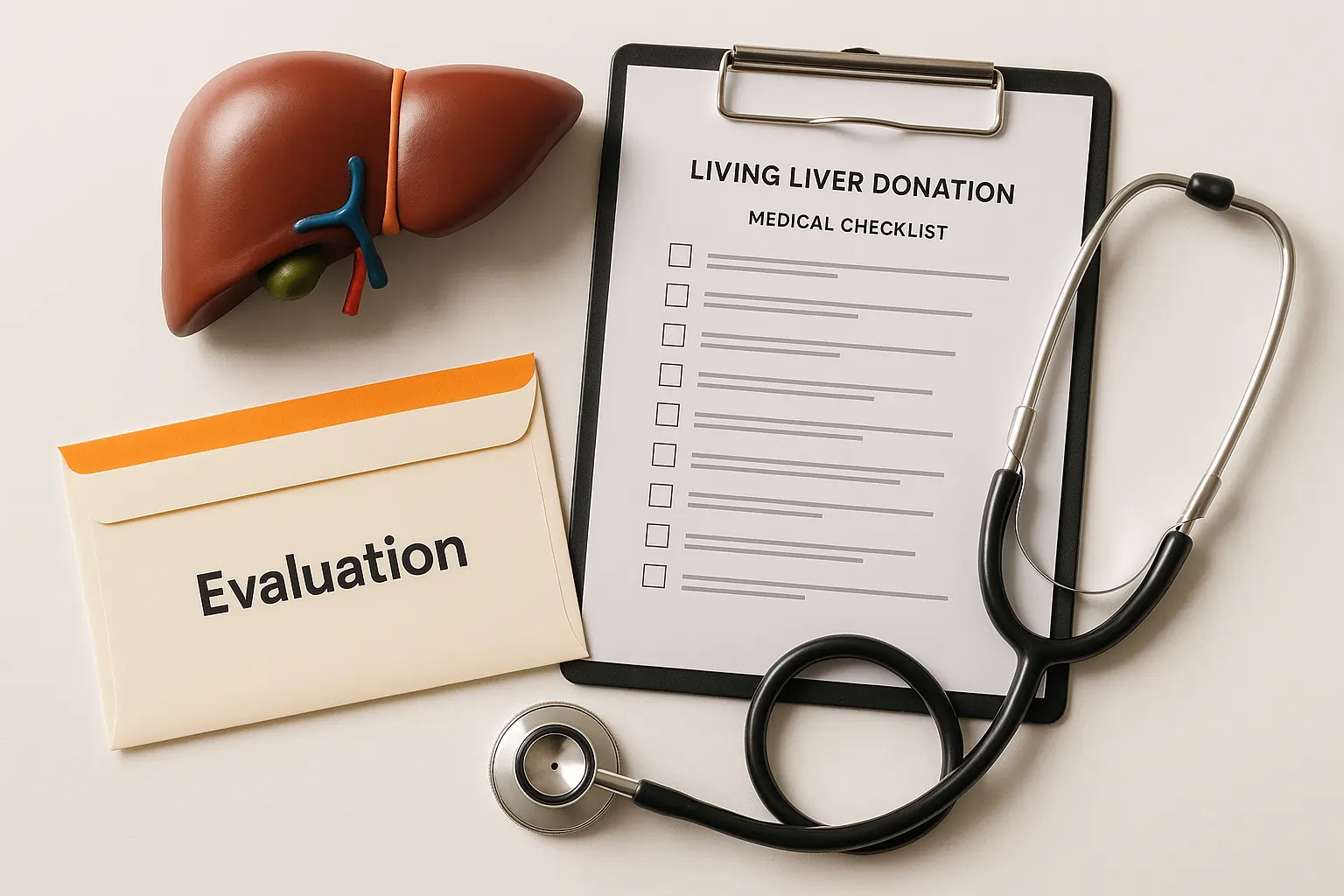
A living liver donation is a life-saving surgery where a healthy person gives a portion of their liver to someone with end-stage liver disease. The remarkable ability of the liver to regenerate means both the donor and recipient can go on to live healthy, full lives.
Welcome. I am Dr. Ashish George, and at our practice in Delhi, we have the profound privilege of guiding families through the journey of Living Donor Liver Transplant. One of the most common and crucial questions we hear is, "Can I be a donor for my loved one?"
This question is born from incredible courage and love. The answer, however, depends on a meticulous evaluation to ensure the absolute safety of both the donor and the recipient. It is not a simple yes or no, but a careful journey through a detailed checklist.
This blog post will serve as your transparent, straightforward guide to the requirements. My goal is to demystify the process and give you a clear understanding of what it takes to become a living liver donor.
The Foundation: The First Layer of Eligibility
Before we dive into the detailed medical checklist, there are a few foundational boxes that must be ticked. These are the non-negotiable starting points.
- Willingness and Lack of Coercion: This is the most important point. The decision must be 100% voluntary, free from any pressure or guilt. Our team, especially our psychosocial experts, works hard to ensure this.
- Age Bracket: Generally, donors should be between 18 and 60 years old. While exceptions can be made for exceptionally healthy individuals outside this range, this is the standard for minimizing surgical risk.
- Blood Type Compatibility: Your blood type (A, B, AB, or O) must be compatible with the recipient's. Think of it as a basic key fitting a lock. While some advanced centers perform incompatible transplants, matching blood types remains the gold standard for a smoother process.
- Relationship to the Recipient: Most donors are close family members—parents, children, siblings—or spouses. However, emotionally connected friends or even altruistic strangers ("Good Samaritan donors") can also be considered. The evaluation for non-relational donors is particularly thorough to ensure pure motivation.
The Comprehensive Medical Checklist: Your Health Comes First
The core of the evaluation is a deep dive into your physical health. Our primary duty is to ensure that donating a part of your liver will not put your own life or long-term health in serious jeopardy. When people search for the best liver surgeon in India, they are often looking for a team that prioritizes donor safety with this level of rigor.
1. Excellent General Health
You should be free from major chronic illnesses that could make a major operation riskier. This includes:
- Uncontrolled heart disease or hypertension
- Significant lung disease
- Poorly controlled diabetes (especially if you require insulin)
- Chronic kidney disease
2. Body Mass Index (BMI) – The Why Matters
You will often read that a BMI of less than 35 is required, and ideally under 32. But let me explain why this is so critical. A higher BMI is closely linked to a condition called Non-Alcoholic Fatty Liver Disease (NAFLD). A fatty liver is not a healthy liver; it's fragile, more difficult to operate on, and does not regenerate as well. Furthermore, a high BMI increases your risk of complications during and after surgery, such as infections and blood clots. Achieving a healthy BMI before evaluation is one of the best things you can do for your own safety.
3. A Perfectly Healthy Liver
This might seem obvious, but it's detailed. We need to confirm:
- No Liver Disease: Your liver must be free from conditions like hepatitis, cirrhosis, or significant fatty liver.
- Adequate Liver Volume: Through precise CT and MRI scans, we calculate the exact size of your liver. The portion we transplant must be large enough to save the recipient, and the portion we leave with you must be sufficient to support your body until it regenerates. This is a precise mathematical calculation.
- Favorable Anatomy: This is a major reason why some medically healthy donors are not a match. The liver's network of blood vessels and bile ducts must have an anatomy that allows us to split it and reconnect it safely. Unusual anatomy can make the operation too risky for the donor.
4. Clean Bill of Health on Major Illnesses
- Cancer: A history of most cancers is a disqualifier, as the disease could recur and the stress of donation could be harmful.
- Infectious Diseases: You must be free from chronic infections like HIV and Hepatitis B or C. (Note: Having antibodies from a Hepatitis B vaccination is a good thing and is often required).
The Lifestyle and Psychosocial Checklist: Your Readiness to Donate
Your physical health is only one part of the picture. Your mental, emotional, and lifestyle readiness is equally important for a successful outcome. This is where our transplant team, including coordinators, social workers, and psychiatrists, provides invaluable support.
Substance Use: Clear and Strict Guidelines
- Alcohol: We need to see a history of non-harmful drinking. Most transplant centers require a period of complete abstinence—typically 3 to 6 months—before the surgery. This proves your liver can recover and ensures you are not dependent on alcohol.
- Tobacco: You must be a non-smoker or be able to quit for a significant period (often 4-8 weeks) before and after surgery. Smoking harms blood vessels and drastically impairs healing.
- Illicit Drugs: Any current use of illicit substances is an absolute barrier to donation.
Mental and Emotional Stability
The psychosocial evaluation is not about judging you. It's about supporting you and ensuring you are making this decision with clear eyes.
- Realistic Expectations: You must fully understand the risks, the painful recovery, the potential for complications, and the fact that there is no guarantee of success for your recipient.
- Strong Support System: You cannot go through this alone. You need family or friends who can help you physically and emotionally during your recovery, which can take 2-3 months.
- Psychological Health: You should be in a stable place mentally. Untreated depression, anxiety, or other psychiatric conditions need to be well-managed before donation.
Financial and Logistical Planning
Let's be practical. Donation requires time and some cost.
- Time Off Work: You will need at least 2 to 3 months to recover before returning to a non-physical job.
- Associated Costs: While the recipient's insurance typically covers the direct medical costs of the transplant, you may have expenses for travel, lodging, and lost wages. We always guide our donors to the National Living Donor Assistance Center (NLDAC), a wonderful program that can help with these costs for qualified donors. Any best liver surgeon in Delhi will have a team that can help you navigate these resources.
Common Disqualifiers: Understanding the "No"
It is important to be transparent about conditions that almost always prevent someone from donating. If you fall into one of these categories, it is for your own safety.
- HIV infection
- Active cancer
- Severe, uncontrolled heart or lung disease
- Significant liver disease or cirrhosis
- Active substance abuse
- Pregnancy (donation is postponed until after delivery and weaning)
The Evaluation Process: What Happens After You Check the Boxes?
So, you've read this checklist and feel you might be a candidate. What's next? The formal process is designed to leave no stone unturned.
- Initial Referral: You contact the transplant center where your recipient is listed.
- Pre-Screening: A coordinator will ask preliminary questions about your health and compatibility.
- Comprehensive In-Person Evaluation: This is a 2-3 day process involving blood tests, imaging scans (CT/MRI), heart and lung tests, and meetings with the best liver surgeon in Delhi, a hepatologist, a psychiatrist, a social worker, and a donor advocate.
- The Final Decision: The entire transplant team meets to discuss your case. Only if everyone agrees that the donation is safe and appropriate for you, will you be approved.
Remember, being declined is not a failure. It is the system working perfectly to protect you.
Why Most Potential Donors Are Not a Match – And Why That’s Okay
This might be a contrarian angle, but it's a truth we see every day. Many more people step forward as donors than are ultimately selected. The most common reasons are:
- Medical issues they were unaware of (like fatty liver or hypertension).
- Anatomic reasons that only show up on advanced scans.
- Psychosocial factors like a lack of support or unresolved pressure.
We see a "no" as a success. It means we prevented a potentially risky situation. The courage to step forward is what matters most.
Your Next Step: From Reading to Action
Reading this checklist is a powerful first step. It shows your commitment and love. If you have reviewed these points and believe you may be a candidate, the journey begins with a simple, courageous step.
If you are considering becoming a living liver donor for a loved one. Contact the transplant center where your recipient is listed, or you can reach out to our team for a confidential discussion. The process is designed to protect you every step of the way, and we are here to answer every question you have.
As a dedicated practitioner focused on Living Donor Liver Transplant in Delhi, my team and I are committed to providing the highest standard of care, ensuring that the gift of life is given and received with the utmost safety and compassion.
Frequently Asked Questions
1. Does the donor's liver really grow back?
Yes, absolutely. It's the magic
of the liver! Within just 6-8 weeks, your liver can regenerate back to nearly its original size
and function.
2. What is the recovery really like for the donor?
You can expect a 5-10 day
hospital stay. The first 2-4 weeks at home require rest and limited activity. Most people feel
back to normal by the 3-month mark, but it can vary.
3. Can I live a completely normal life after donation?
Yes. Once you have
fully recovered, you can return to all your normal activities, including exercise, work, and for
most, a normal diet. We provide lifelong follow-up to ensure your continued health.