Rejected as a Liver Donor? How Families in Delhi Still Get a Living Donor Liver Transplant
.webp)
Principal Consultant & Unit Head, Liver Transplant & HPB Surgery, Fortis Hospital, Shalimar Bagh, Delhi
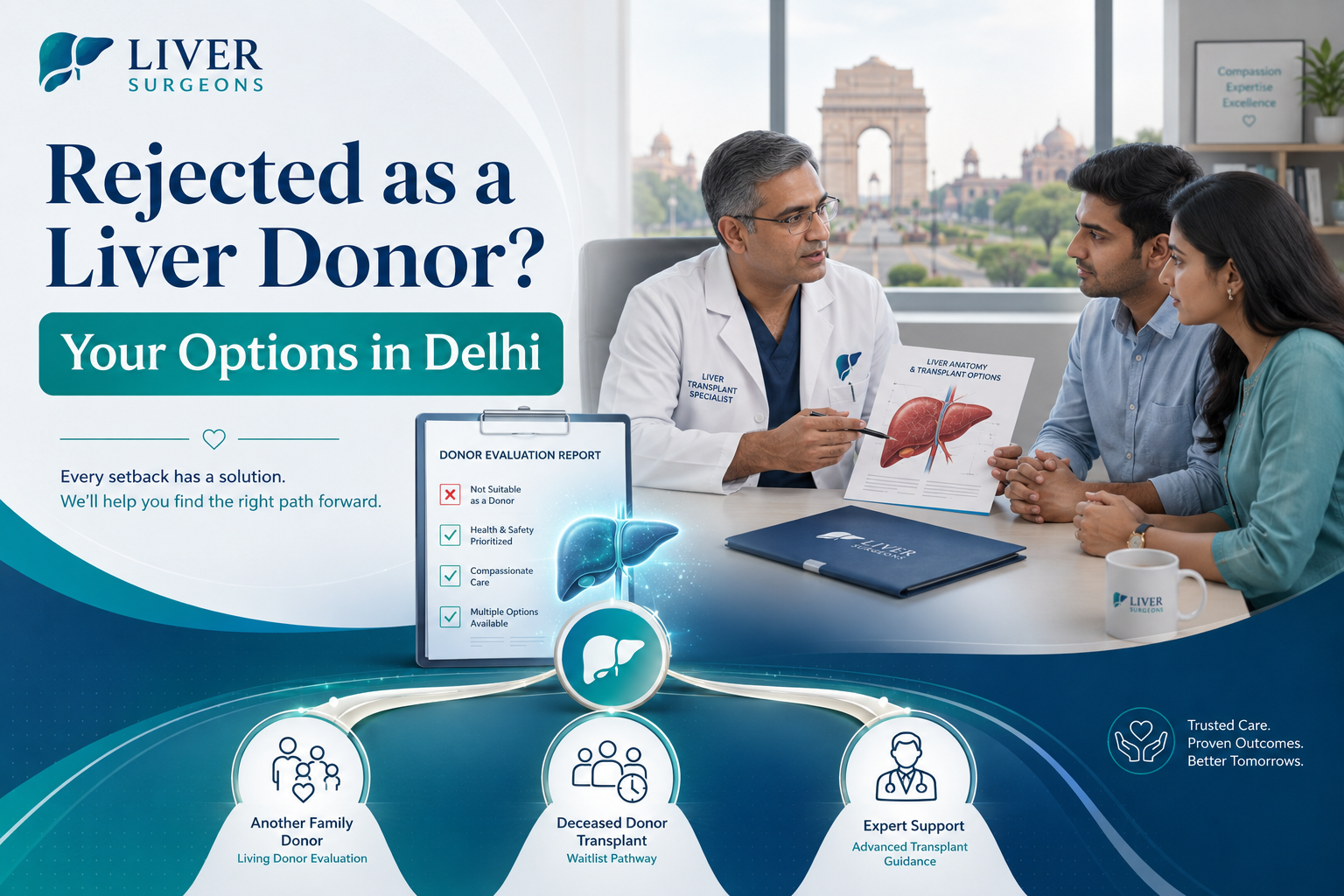
It is one of the hardest moments in a family's transplant journey. A father, a sister, a son steps forward and says, “Take part of my liver.” Everyone breathes a little easier until the evaluation comes back and the transplant team says the words no one expected: “This donor isn't eligible.”
If you have just heard that, take a breath. Being turned down as a living liver donor is far more common than families realise, and in most cases it is not the end of the road. In this guide, a Delhi liver surgeon explains why donors get rejected, which reasons are temporary and which are permanent, and the real options that still lead to a living donor liver transplant in Delhi or another safe route to a new liver.
First: a “no” is a sign the system is working
Before we talk about options, understand why donors are screened so strictly. A living donor is a healthy person undergoing major surgery purely to help someone else. Donor safety therefore comes before everything including the urgency of the patient's condition. When a team declines a donor, it is protecting that donor from harm. A careful “no” is a feature of a good programme, not a failure of one.
The encouraging part: many reasons for rejection are temporary and fixable, and even when one relative can't donate, there is often more than one path to transplant.
Why living liver donors get rejected
Rejection usually comes down to one of these findings during evaluation:
- Fatty liver. The most common and most often reversible reason. A liver with significant fat is unsafe to donate from.
- Blood group mismatch. The donor's blood group isn't compatible with the recipient's under the standard protocol.
- High BMI / excess weight. Often linked to fatty liver, and raises the donor's own surgical risk.
- Liver size or anatomy. The graft would be too small for the recipient, or the remnant left behind would be too small to keep the donor safe. Unusual blood-vessel or bile-duct anatomy can also rule a donor out.
- Medical conditions. Uncontrolled diabetes, significant heart disease or active cancer make donor surgery unsafe.
- Age or psychological factors. Donors outside the usual age range, or any sign that consent isn't fully free and informed.
If you want the full checklist we assess against, see our companion guide on who qualifies as a living liver donor. The key question to ask your team is simple: is this reason temporary or permanent?
The good news: several of these can be fixed or worked around
1. If it's fatty liver or extra weight you may re-qualify
This is the single most hopeful scenario, because fatty liver is often reversible. With a structured weight-loss and diet plan and, where appropriate, medical support many would-be donors clear the fat from their liver within a few weeks to a few months and pass on re-evaluation. We regularly see relatives who were declined return, re-test, and go on to donate safely.
If this is your situation, ask for a target and a timeline, then start straight away. Our guides on how to reverse fatty liver and fatty liver treatment in Delhi are a good starting point but do it under medical guidance so the recipient isn't kept waiting longer than necessary.
2. If it's a blood group mismatch ask about ABO-incompatible transplant
A different blood group no longer automatically disqualifies a donor. Through an ABO-incompatible (ABOi) protocol which lowers the recipient's antibodies before surgery using medication and, where needed, plasma exchange a mismatched relative can often still donate. In experienced, high-volume centres, outcomes for ABO-incompatible living donor transplants are now close to those of matched transplants.
Not every hospital offers this, so if a blood-group mismatch was the only barrier, it is worth asking specifically whether ABO-incompatible transplant is an option for your family.
3. If one donor can't give enough liver dual-lobe (two donors)
Sometimes a single donor is healthy but simply can't safely provide a large enough graft often when the recipient is a big adult. In that case, a dual-lobe liver transplant can combine grafts from two willing relatives, so each gives a smaller, safer portion. Two people who each felt they “weren't enough” can, together, save a life.
4. If no relative qualifies the deceased donor route stays open
If every potential family donor is ruled out, a deceased donor liver transplant through the national NOTTO system is still a life-saving option. Register early don't wait until every donor has been exhausted. Our guide to how the deceased donor waiting list works in India explains MELD scores, allocation and likely waiting times.
What to do right now a 5-step action plan
- Get the exact reason. Ask the team precisely why the donor was declined and whether it's temporary (fatty liver, weight) or permanent (anatomy, serious illness).
- If it's reversible, get a plan and a re-test date. A clear target plus a re-evaluation timeline keeps everyone moving.
- Ask about ABO-incompatible and dual-lobe options. A mismatch or a small graft is not always a dead end but you have to ask.
- Register on the deceased donor list in parallel. Run both tracks at once; you can always step back if a living donor qualifies.
- Get a second opinion at a high-volume centre. Programmes that do a large number of living donor transplants tend to have the most options and experience with complex cases.
A word on trust
Under India's Transplantation of Human Organs and Tissues Act (THOTA), living donation is tightly regulated and every donor is protected by an independent evaluation. If your donor was declined, it wasn't a bureaucratic hurdle it was the safeguard doing exactly what it should. The same rigour that protected your relative is what makes the alternatives above safe to pursue.
Frequently asked questions
Can a person with fatty liver donate part of their liver?
Not while the fatty liver is present, because it makes donor surgery unsafe. But fatty liver is often reversible many donors who lose weight and clear the fat from their liver re-qualify on a repeat evaluation.
Can I donate if my blood group doesn't match the recipient's?
Often, yes through an ABO-incompatible protocol that reduces the recipient's antibodies before surgery. Ask whether your centre offers ABO-incompatible living donor liver transplant.
Two relatives want to help but neither can give enough liver. Is there a way?
Yes. A dual-lobe liver transplant combines grafts from two donors, so each gives a smaller, safer portion.
How long does it take to re-qualify after reversing fatty liver?
It varies by person, but many donors improve enough within a few weeks to a few months of committed diet and weight loss. Your team will set a target and a re-test date always do this under medical guidance.
If no one in my family can donate at all, what are my options?
A deceased donor liver transplant through NOTTO. Register early and keep this track running alongside any living-donor attempts.
You still have options let's find yours
A rejected donor is a setback, not the end of the story. Whether the next step is reversing a fatty liver, an ABO-incompatible transplant, a dual-lobe procedure or the deceased donor list, most families have a path forward they just need the right team to map it. If your donor was declined and you want a clear, honest second opinion, book a consultation with Dr. Ashish George.