What Is the Whipple Procedure and Who Needs It?

Principal Consultant & Unit Head, Liver Transplant & HPB Surgery, Fortis Hospital, Shalimar Bagh, Delhi
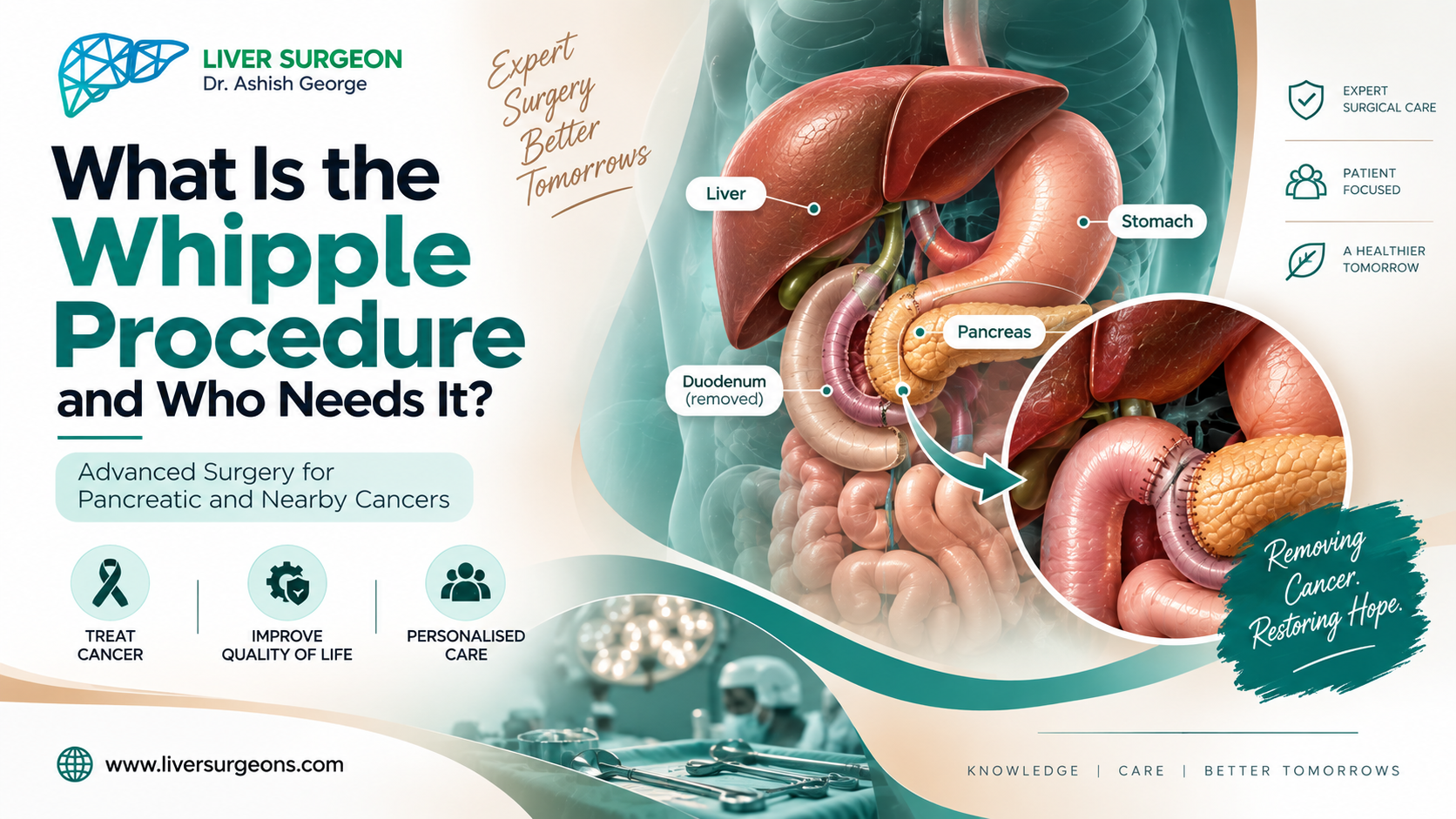
The Whipple is one of the most complex operations in abdominal surgery, and for many patients it is the only route to a cure. Here is what it involves and who needs it.
The Whipple procedure, known medically as pancreaticoduodenectomy, is one of the most important and most complex operations in hepatobiliary and pancreatic surgery. For people with a tumour in the head of the pancreas or the nearby bile duct, it is often the only treatment that offers a chance of cure. This guide explains in plain language what the Whipple procedure is, what it treats, who needs it, what recovery is like, and why the choice of surgeon matters so much.
What Is the Whipple Procedure?
The Whipple procedure (pancreaticoduodenectomy) removes the head of the pancreas along with several structures attached to it, and then reconstructs the digestive system so it works again. It is a long, technically demanding operation that removes and rebuilds in one surgery. It is used mainly to remove cancers, and sometimes severe benign disease, in and around the head of the pancreas.
What Does the Whipple Procedure Remove?
In a standard Whipple, the surgeon removes:
- The head of the pancreas
- The duodenum (the first part of the small intestine)
- The gallbladder
- Part of the bile duct
- Sometimes part of the stomach, and nearby lymph nodes
The surgeon then reconnects the remaining pancreas, bile duct, and stomach to the small intestine so that digestion can continue. This reconstruction is as demanding as the removal itself.
What Conditions Does the Whipple Procedure Treat?
| Condition | Why a Whipple Is Used |
|---|---|
| Pancreatic head cancer | The most common reason; removes the tumour with a chance of cure |
| Distal bile duct cancer (cholangiocarcinoma) | Tumours in the lower bile duct near the pancreas |
| Ampullary and duodenal cancer | Cancers where the bile and pancreatic ducts meet the intestine |
| Some neuroendocrine tumours | Selected tumours of the pancreatic head |
| Severe chronic pancreatitis (head) | When disease and pain are concentrated in the pancreatic head |
For the surgical detail of each cancer, see our pages on pancreatic cancer surgery in Delhi, cholangiocarcinoma and bile duct cancer surgery, and chronic pancreatitis surgery.
Who Needs a Whipple Procedure?
You may need a Whipple procedure if you have a tumour or severe disease in the head of the pancreas, the lower bile duct, or the ampulla, and the tumour is resectable, meaning it can be removed completely. The decision depends on where the tumour is, whether it involves major blood vessels, and your overall fitness for major surgery. This is assessed with CT or MRI scans and reviewed by a multidisciplinary tumour board before surgery.
Open, Laparoscopic, or Robotic Whipple?
A Whipple can be done by open surgery or, in suitable cases, by minimally invasive (laparoscopic or robotic) surgery. Minimally invasive Whipple can mean less pain and faster recovery, but it is technically very demanding and only appropriate for selected patients. The right approach depends on the tumour and the surgeon's experience. Learn more about robotic HPB surgery in Delhi.
What Is Recovery Like After a Whipple?
A Whipple is major surgery with a meaningful recovery period:
- Hospital stay: usually about 1 to 2 weeks, with the first days in a high-dependency or intensive care unit
- Return to normal activity: generally 6 to 8 weeks for open surgery, faster for minimally invasive cases
- Digestion: some patients need pancreatic enzyme supplements to help digest food afterwards
- Further treatment: for cancer, chemotherapy is often given after the surgery
What Are the Risks?
Because it removes and rebuilds several organs, the Whipple carries real risks, the main one being a pancreatic leak from the new join, as well as delayed stomach emptying, bleeding, and infection. The single most important factor in keeping these risks low is surgeon and hospital volume. Study after study shows that complication and death rates are substantially lower when the Whipple is done by a high-volume HPB surgeon at a centre that performs many of these operations each year.
Why Choosing the Right Surgeon Matters So Much
The Whipple is often described as one of the operations where experience matters most. A high-volume HPB surgeon not only performs the removal and reconstruction more safely, but also manages complications like a pancreatic leak better when they occur. If you or a family member has been advised to have a Whipple, it is completely reasonable, and wise, to seek an experienced pancreatic surgeon and, if needed, a second opinion.
Whipple Procedure in Delhi
At Liver Surgeons, Dr. Ashish George performs the Whipple procedure at Fortis Hospital, Shalimar Bagh, Delhi, as part of a high-volume HPB and cancer surgery programme, with open, laparoscopic and robotic options, intraoperative support, and a full multidisciplinary tumour board. Patients told elsewhere that surgery is too risky or not possible are welcome to seek a second opinion. For out-of-city and international patients, scans can be reviewed remotely before travel.
Frequently Asked Questions
What is the Whipple procedure in simple terms?
It is an operation that removes the head of the pancreas, the duodenum, the gallbladder and part of the bile duct, then reconnects the remaining organs so digestion continues. It is used mainly to remove cancers around the head of the pancreas.
Who needs a Whipple procedure?
People with a resectable tumour or severe disease in the head of the pancreas, the lower bile duct, or the ampulla. Suitability is decided with scans and a tumour board based on tumour location, vessel involvement, and fitness for surgery.
How long does recovery take?
Hospital stay is usually 1 to 2 weeks, with return to normal activity in about 6 to 8 weeks for open surgery and faster for minimally invasive cases. Some patients need enzyme supplements to aid digestion.
Is the Whipple procedure dangerous?
It is major surgery with real risks, the main one being a pancreatic leak. However, risks are substantially lower when the operation is done by a high-volume HPB surgeon at an experienced centre.
Can a Whipple be done by keyhole or robotic surgery?
Yes, in selected patients. Minimally invasive and robotic Whipple can reduce pain and speed recovery, but they are technically demanding and suited only to certain cases. The approach depends on the tumour and the surgeon's experience.
Conclusion
The Whipple procedure is a complex but often life-saving operation, and for many pancreatic and bile duct tumours it is the only path to a cure. The key to a safe outcome is having it done by an experienced, high-volume HPB surgeon. If a Whipple has been advised for you or your family, or you want a second opinion, book a consultation with Dr. Ashish George at Fortis Hospital, Shalimar Bagh, Delhi.