Types of Cholangiocarcinoma by Location
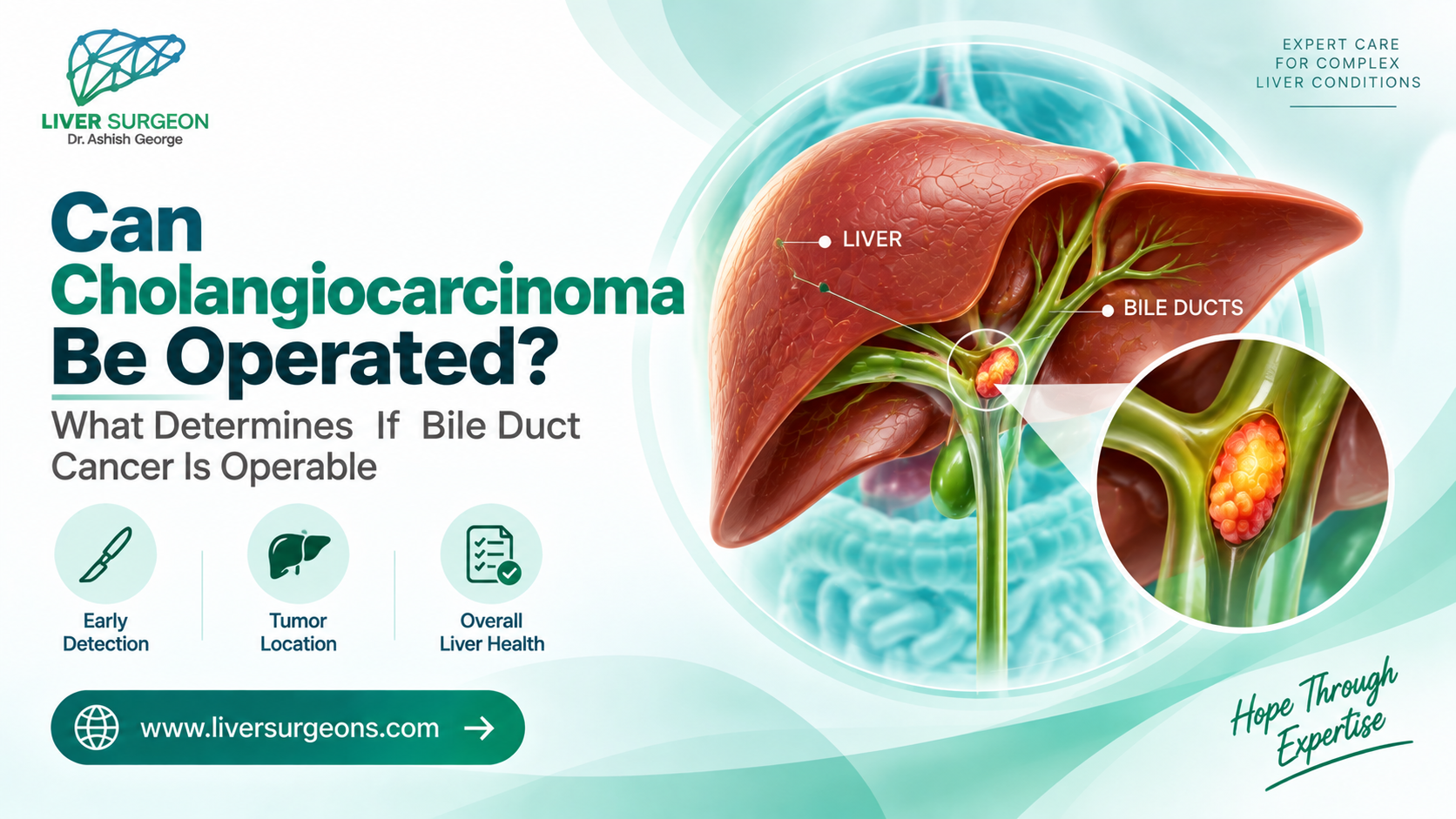
Cholangiocarcinoma is classified by where in the biliary tree it arises. Location
determines the operation, the difficulty, and the outlook, which is why an accurate
diagnosis of type comes first. The three main types are:
| Type |
Where It Arises |
Usual Surgery |
| Perihilar (Klatskin tumour) |
At the liver hilum where the right and left ducts join. This is the
most common site of cholangiocarcinoma.
|
Major liver resection with bile duct removal and reconstruction;
the most complex type.
|
| Distal |
In the lower bile duct near the pancreas. |
Whipple surgery (pancreaticoduodenectomy). |
| Intrahepatic (peripheral cholangiocarcinoma) |
Within the liver itself, in the smaller ducts. |
Liver resection (hepatectomy), sometimes laparoscopic. |
Hilar cholangiocarcinoma types: Perihilar (Klatskin) tumours are
further sub-classified by the Bismuth-Corlette system according to how far the
tumour extends into the right and left duct branches. This sub-typing decides how
much liver must be removed and whether the tumour is resectable, which is why a
Klatskin tumour surgeon in Delhi with high-volume hilar experience
is essential. Perihilar disease is both the most common and the most surgically
demanding form of the disease.
Symptoms of Bile Duct Cancer
Early cholangiocarcinoma often causes no symptoms, which is part of why it is
dangerous. As the tumour blocks the bile duct, the common
bile cancer symptoms are:
-
Jaundice: Yellowing of the skin and eyes, usually the first
noticeable sign, from bile backing up into the blood.
-
Dark urine and pale stools: A direct result of blocked bile
flow.
-
Itching: Caused by bile salts building up in the skin.
-
Unexplained weight loss and loss of appetite.
-
Abdominal pain: Usually in the upper-right area, along with
general fatigue.
Painless jaundice in particular should always be investigated urgently. If you or a
referring doctor suspect bile duct cancer, prompt specialist assessment is
important because the window for curative surgery can be narrow.
Cholangiocarcinoma Staging and Resectability
Accurate cholangiocarcinoma staging is the foundation of treatment.
Staging uses high-quality cross-sectional imaging, including triple-phase CT and
MRI with MRCP, to establish the size and spread of the tumour, its relationship to
the portal vein and hepatic artery, the extent of duct involvement, and whether
lymph nodes or distant sites are affected. The formal system is the TNM
classification, which describes the tumour (T), lymph nodes (N) and metastasis (M).
The most important question staging answers is whether the tumour is
resectable. Resectable tumours are treated with surgery aimed at
complete removal. Locally advanced cholangiocarcinoma that involves major vessels
or extends too far along both ducts may not be immediately resectable, but is not
automatically inoperable. Vascular reconstruction, staged surgery, or downstaging
chemotherapy can sometimes convert an advanced tumour into a resectable one. This
judgement is exactly what a high-volume specialist provides.
Cholangiocarcinoma Surgery Procedures at Our Delhi Centre
The table below covers every cholangiocarcinoma surgery procedure
performed at our Delhi centre and the situation each one suits.
| Procedure |
When Used |
Goal |
| Perihilar (Klatskin) Resection |
Tumour at the liver hilum. |
Remove the affected ducts and liver lobe en-bloc with
reconstruction, aiming for a clear (R0) margin.
|
| Whipple Surgery (Pancreaticoduodenectomy) |
Distal bile duct tumour near the pancreas. |
Remove the lower duct, pancreatic head and duodenum together.
|
| Liver Resection (Hepatectomy) |
Intrahepatic (peripheral) cholangiocarcinoma. |
Remove the tumour-bearing segment or lobe of liver.
|
| Radical Resection with Lymphadenectomy |
All curative cases. |
En-bloc removal with regional lymph nodes to reduce recurrence.
|
| Vascular Reconstruction |
Tumours involving the portal vein or hepatic artery. |
Resect and rebuild the involved vessel to allow complete removal.
|
| Palliative Biliary Drainage or Bypass |
Advanced tumours not suitable for cure. |
Relieve jaundice and itching, restore bile flow, and improve quality
of life.
|
For tumours that also involve the bile duct wall beyond the cancer margin, or where
reconstruction of the biliary tree is complex, our
bile duct reconstruction expertise
is applied within the same operation. Tumours involving major hepatic veins or the
vena cava may need
advanced ante-situm or ex-situ resection
,
which our centre also offers.
Why Margin-Negative (R0) Resection Matters
The most important predictor of long-term survival in cholangiocarcinoma is whether
the surgeon achieves a margin-negative resection, meaning no cancer
cells remain at the cut edge. This is why we use
intraoperative frozen section analysis to check margins during
surgery and extend the resection there and then if needed. A margin-negative result
depends heavily on surgical volume and judgement, which is the single strongest
reason to choose an experienced HPB surgeon for bile duct cancer
rather than a general surgeon.
Cholangiocarcinoma Complications and Multimodal Care
Understanding cholangiocarcinoma complications, both of the disease
and of its surgery, is part of informed treatment:
-
Biliary obstruction and jaundice: The disease itself blocks
bile flow; relieved by surgery or, in advanced cases, by drainage or stenting.
-
Cholangitis: Infection of the obstructed bile system, which can
be serious and needs prompt treatment.
-
Liver failure risk: Major liver resection requires a sufficient
future liver remnant, sometimes needing portal vein embolisation first to grow
the remnant.
-
Post-operative bile leak or infection: Managed in a dedicated
HPB unit with interventional radiology support.
-
Recurrence: Addressed with adjuvant chemotherapy after surgery
and, in selected cases, re-resection.
Surgery is almost never the whole answer on its own.
Adjuvant chemotherapy after cholangiocarcinoma surgery targets any
residual cancer cells and is now standard for most resected patients. Our Delhi
team plans every case jointly with medical and radiation oncology so that surgery,
chemotherapy and, where appropriate, radiation work together.
Choosing the Best Cholangiocarcinoma Surgeon in Delhi
Cholangiocarcinoma is one of the most technically demanding cancers in abdominal
surgery, and outcomes are strongly tied to how many cases the surgeon and centre
handle each year. When choosing a
bile duct cancer specialist in Delhi, or searching for the
best cholangiocarcinoma surgeon in Delhi or the
best bile duct cancer surgeon in Delhi, consider:
-
Hilar case volume: Ask specifically how many perihilar
(Klatskin) resections the surgeon performs each year, as this is the hardest
type.
-
Full range of operations: A genuine
biliary cancer surgeon in Delhi offers liver resection, Whipple
surgery, vascular reconstruction and biliary reconstruction, and chooses
between them based on tumour location.
-
Multidisciplinary team: The best centres decide every case at a
tumour board with oncology and radiology, not by a single surgeon alone.
-
R0 focus: A surgeon who uses intraoperative frozen section to
confirm clear margins.
Dr. Ashish George, Cholangiocarcinoma Specialist, Fortis Shalimar Bagh, Delhi
Dr. Ashish George
is among the leading cholangiocarcinoma specialists in Delhi, with
more than 15 years of HPB experience across perihilar, distal and intrahepatic
disease. Patients searching for a
cholangiocarcinoma doctor in Delhi or the
best cholangiocarcinoma doctor are referred to his team from across
North India and abroad.
As a high-volume cholangiocarcinoma hospital in Delhi and
bile duct cancer treatment hospital in Delhi, Fortis Shalimar Bagh
combines a dedicated HPB unit, 3D surgical planning, intraoperative frozen section
analysis, and a full tumour board. Patients receive world-class
bile duct cancer treatment in Delhi at costs substantially lower
than in Western countries, without any compromise in surgical or oncological care.
Second Opinion for Cholangiocarcinoma in Delhi
If you have been told your bile duct cancer is inoperable, or you simply want to be
sure the plan is right before committing to major surgery, a
second opinion for cholangiocarcinoma in Delhi is worthwhile and
often changes the plan. "Inoperable" at a non-specialist centre frequently means
the tumour cannot be removed with the techniques available there, not that it
cannot be removed at all. Vascular reconstruction, staged resection and
downstaging chemotherapy can bring locally advanced tumours back into the
resectable range in experienced hands.
-
Remote review: Review of your imaging and pathology by
Dr. George's team.
-
Clear surgical opinion: An honest assessment of whether the
tumour is resectable and what the realistic treatment options are.
-
Coordinated treatment: Coordination with your existing
oncologist so care is joined up rather than duplicated.
About Cholangiocarcinoma: Incidence and Risk
Cholangiocarcinoma is uncommon but its incidence is rising
worldwide. It accounts for a small percentage of all gastrointestinal cancers, and
perihilar disease at the liver hilum is the most common site. Known
risk factors include primary sclerosing cholangitis, chronic biliary infection and
parasitic infestation, bile duct stones and cysts, chronic liver disease, and some
chemical exposures. Many patients, however, have no identifiable risk factor.
Because early disease is silent, any persistent jaundice, itching or unexplained
weight loss deserves prompt investigation.
International and Out-of-City Patients
Delhi is one of Asia's established destinations for bile duct cancer surgery,
combining high case volume with costs typically 60 to 75 percent lower than
comparable procedures in the United Kingdom, United States, or Australia. For
patients travelling to Dr. George's practice:
-
Pre-travel assessment: Remote video consultation and imaging
review before travel.
-
Medical visa assistance: Visa support letters for medical
travel on confirmation of a surgical appointment.
-
Oncology coordination: Coordination with the patient's home
oncologist for continuity of adjuvant treatment.
-
Remote follow-up: Post-operative follow-up and pathology
reviewed remotely after the patient returns home.