How to Find the Best Liver Transplant Surgeon in Delhi: A Patient's Guide
.webp)
Principal Consultant & Unit Head, Liver Transplant & HPB Surgery, Fortis Hospital, Shalimar Bagh, Delhi

Choosing a liver transplant surgeon is one of the most consequential decisions a patient and their family will ever make. The liver is the most complex organ to transplant. The surgery involves multiple teams working simultaneously, intricate vascular reconstruction, and a long post-operative recovery that demands ongoing specialist oversight.
In Delhi, there are several surgeons and hospitals offering liver transplant services. The range of experience, outcomes, and infrastructure varies considerably. This guide walks through the criteria that actually matter when evaluating a surgeon, the questions you should ask during a consultation, and the indicators of a high-quality liver transplant program.
Why Surgeon Choice Matters More Than Hospital Brand
Patients often focus on the hospital name rather than the specific surgeon and team they will be working with. That is understandable, but it can lead to misplaced decisions. A famous hospital with a newly established liver transplant unit may carry more institutional risk than a specialist unit at a less-known hospital led by a high-volume, experienced surgeon.
Research consistently shows that outcomes in liver transplantation are closely correlated with centre volume and individual surgeon experience. A program performing fewer than 20 to 30 transplants per year carries a meaningfully different risk than one performing over 100. According to data published in transplant outcome studies, high-volume centres demonstrate lower 30-day mortality, lower graft failure rates, and better 5-year survival statistics.
This does not mean that smaller programs cannot provide excellent care. But it does mean that you should ask specific questions rather than relying on a hospital's broader reputation.
Key Credentials to Look For
Surgical Training in Hepatobiliary Surgery
Liver transplant surgery in India requires postgraduate training in surgical gastroenterology or general surgery, followed by a dedicated fellowship in transplant surgery. The two most respected pathways are an M.Ch. in Surgical Gastroenterology from AIIMS or a similar premier institution, followed by post-doctoral fellowship training in transplant surgery.
Surgeons trained at institutions like AIIMS New Delhi, PGI Chandigarh, or through fellowships at internationally recognised transplant centres in the UK, USA, or France typically bring a higher standard of technical training.
Transplant Volume and Outcomes
Ask the surgeon directly: how many liver transplants have you personally performed? What is your program's 1-year graft survival rate? These are not unreasonable questions. Any experienced transplant surgeon will be comfortable answering them. As a benchmark, programs with over 500 to 1,000 transplants and a 1-year survival rate above 90 per cent are considered high-performing by international standards.
Range of Procedures Handled
A strong liver transplant program should be capable of handling not just standard adult living donor transplants but also deceased donor transplants, pediatric transplants, ABO-incompatible transplants, and complex cases like combined liver-kidney transplants. The complexity range handled by a program is a direct indicator of its depth of expertise.
Institutional Membership and Recognition
Active membership in the Liver Transplant Society of India (LTSI) and the Association of Surgeons of India (ASI) is a baseline expectation. Surgeons who present at national and international transplant conferences, publish research, or participate in outcomes audits are generally more engaged with the evolving standards of the field.
Questions to Ask During Your First Consultation
Most patients feel hesitant to question their doctors. But in transplant surgery, an informed patient is a safer patient. Here are questions worth asking:
- How many liver transplants have you personally performed? Not the team, not the hospital. You.
- What is your program's 1-year and 5-year graft survival rate?
- Does your program handle living donor, deceased donor, and pediatric transplants?
- What happens if there are complications post-transplant? Who manages that, and where?
- What does the post-transplant follow-up protocol look like for the first year?
- Is the hospital part of a regional organ allocation network for deceased donor organs?
- What imaging, ICU, and diagnostic infrastructure does the hospital have dedicated to liver patients?
A surgeon who welcomes these questions and answers them clearly is demonstrating the kind of transparency and confidence that is worth trusting.
About Dr Ashish George
Dr Ashish George is the Principal Consultant and Unit Head of the Department of Liver Transplant and HPB Surgery at Fortis Hospital, Shalimar Bagh, Delhi. He completed his MBBS and MS in General Surgery from the University College of Medical Sciences, Delhi, followed by an M.Ch. In Surgical Gastroenterology from AIIMS New Delhi. He holds a Post-Doctoral Fellowship in Liver Transplantation from TNMGR University, Chennai, and a Fellowship in Minimal Access Surgery from WLH.
His clinical experience spans over 1,000 successful liver transplant surgeries, including pediatric transplants, ABO-incompatible transplants, combined liver-kidney transplants, and complex hepatobiliary procedures. Prior to his current role at Fortis Shalimar Bagh, he held senior positions at Aakash Healthcare Superspecialty Hospital and BLK-Max Superspecialty Hospital in New Delhi.
Dr George is an active member of the Liver Transplant Society of India (LTSI) and the Association of Surgeons of India (ASI). His approach combines technical precision with a focus on transparent, patient-centred communication throughout the pre-transplant and post-transplant journey.
The Infrastructure Behind a Good Transplant Outcome
A great surgeon operating in a poorly equipped hospital faces unnecessary obstacles. The infrastructure supporting a liver transplant program matters as much as individual surgical skill. At a minimum, a high-quality transplant centre should have:
- A dedicated liver ICU: Round-the-clock monitoring by trained transplant hepatology nurses and intensivists, not shared ICU beds.
- Hybrid operating theatres: Real-time intraoperative imaging is critical for complex vascular reconstruction during transplant surgery.
- Advanced diagnostics on-site: FibroScan, 3D CT imaging, intraoperative ultrasound, and dedicated pathology for liver biopsies.
- A full hepatology team: Post-transplant care is managed as much by hepatologists as by surgeons. A centre without strong hepatology support will struggle with complication management.
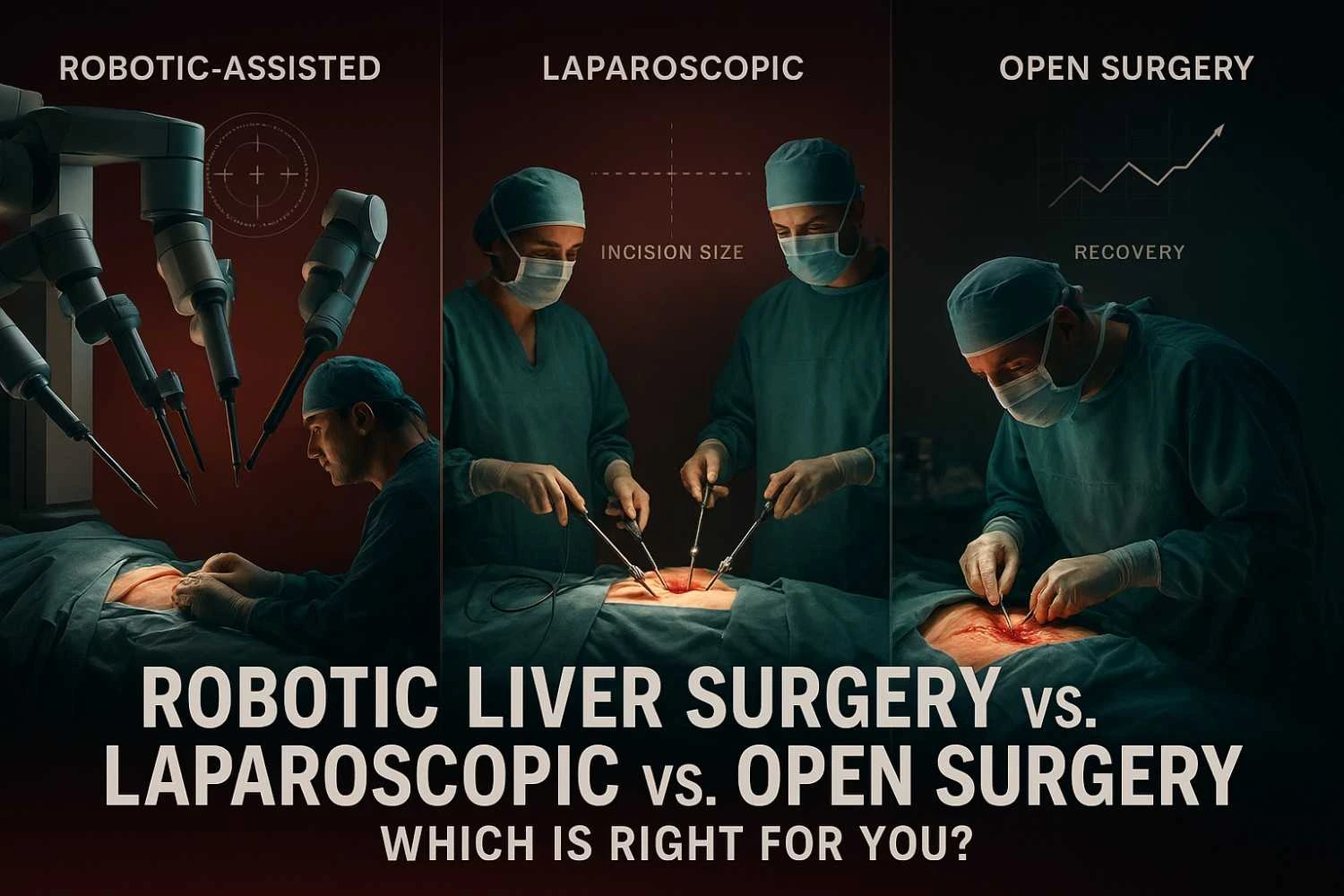
- Robotic and minimal access capability: Increasingly, high-volume centres are using laparoscopic and robotic approaches to reduce donor-side morbidity.
Red Flags to Watch For
Not every program that offers liver transplants should be trusted with your case. Watch out for:
- Surgeons or hospitals that cannot quote specific outcome data when asked
- Programs with fewer than 20 to 30 transplants per year for standard adult living donor cases
- Centres that lack a dedicated liver ICU or rely on general ICU beds for transplant patients
- Situations where the transplant surgeon will not be personally operating, and a junior team will handle the case
- Hospitals that give a single lump-sum quote without an itemised breakdown of what is included
Frequently Asked Questions
What is the difference between a liver transplant surgeon and a hepatologist?
A hepatologist is a physician who diagnoses and medically manages liver diseases. A liver transplant surgeon is a surgeon who performs the actual transplant operation and the related HPB procedures. The best transplant programs work closely together.
Can I get a second opinion before choosing a surgeon?
Absolutely, and you should. A reputable surgeon will not take offence. If a surgeon discourages you from seeking a second opinion, that is itself a warning sign.
Does the surgeon's gender matter?
Not from a clinical perspective. What matters is training, volume, and institutional support. Choose based on credentials and outcomes, not personal attributes.
How soon should I consult a transplant surgeon after diagnosis?
As soon as a hepatologist or gastroenterologist mentions that a transplant may be needed, request a referral immediately. Early evaluation allows for thorough workup, proper listing, and better planning. Waiting until a patient is in crisis significantly increases surgical risk.
Book a Consultation
If you are looking for an experienced liver transplant specialist in Delhi for an evaluation, consultation, or second opinion, our team at Fortis Hospital Shalimar Bagh is available.
Book an appointment with Dr Ashish George at Fortis Hospital, Shalimar Bagh. Call +91 93101 39800 or visit liversurgeons.com/contact. You can also book via the Fortis Healthcare website.
Early evaluation leads to better outcomes. Do not delay.