Liver Cirrhosis Skin Symptoms: What These Warning Signs Mean
.webp)
Principal Consultant & Unit Head, Liver Transplant & HPB Surgery, Fortis Hospital, Shalimar Bagh, Delhi
Meera was washing dishes when she noticed something odd. Her palms had turned a bright red color, almost like sunburn, but she hadn't spent time in the sun. She shrugged it off. Three months later, she developed unexplained itching that kept her awake at night. Her skin felt rough and looked darker in patches. She visited multiple doctors. No one connected the dots.
Then came the day she vomited blood.
In the emergency room, her liver specialist told her something that changed everything: those red palms, the itching, the dark skin patches were all warning signs of advanced liver cirrhosis. Meera's body had been sending distress signals for months, written in symptoms on her skin. But nobody recognized the language.
This story happens more often than you'd think. As a liver surgeon in Delhi who has treated thousands of patients, I've seen how liver disease hides in plain sight. The skin tells stories that many people, including doctors, miss. Understanding these warning signs can mean the difference between catching cirrhosis early and facing a life-threatening emergency.
In this guide, I'll walk you through the skin symptoms that signal liver cirrhosis, the ones most people don't realize matter, the ones that doctors often overlook, and the ones that demand immediate medical attention.
Understanding Liver Cirrhosis And Your Skin
What exactly is liver cirrhosis? Think of your liver like a factory. When it works properly, it filters toxins from your blood, produces proteins, and breaks down hormones. Cirrhosis means scar tissue has replaced healthy liver tissue. This scarring blocks blood flow and damages the organ's ability to function.
Here's what most people don't realize: your skin becomes the first place where damage from liver cirrhosis shows up. Why? Because your liver controls three critical processes that affect skin health: hormone breakdown, toxin elimination, and nutrient absorption.
When cirrhosis develops, these systems start to fail. Hormones, especially estrogen, build up in your bloodstream instead of being broken down. Toxins that should be eliminated start accumulating in your body. Your liver can't properly absorb and store vitamins and minerals that keep skin healthy.
The result? Your skin starts sending warning signals through symptoms that seem unrelated but all point to the same problem. These signs of liver failure skin are what we're going to explore in detail.
The Four Mechanisms Behind Liver Cirrhosis Skin Symptoms
Before I explain specific symptoms, you need to understand how cirrhosis of the skin actually works. There are four main mechanisms at play.
First: Hormonal Imbalance (Especially Estrogen)
Your liver breaks down estrogen. In healthy people, hormones move through the body and get metabolized without building up. In liver cirrhosis patient cases, estrogen accumulates because the scarred liver can't process it efficiently. This excess estrogen causes blood vessels near your skin's surface to dilate and become visible. It's like turning up the pressure on a garden hose and watching the water spray farther.
Second: Vascular Dysfunction (Blood Vessel Problems)
Cirrhosis increases pressure in your portal vein, the major blood vessel that carries blood to your liver. This pressure change forces your body to find alternative routes for blood flow. Small blood vessels near your skin's surface expand to handle this extra blood. These expanded vessels become visible as spider veins or as patches of red skin. This is directly related to skin liver cirrhosis manifestations.
Third: Detoxification Failure (Toxins Building Up)
A healthy liver removes toxins from your blood continuously. Scarred liver tissue can't do this job effectively. Ammonia, bilirubin, and other waste products accumulate in your bloodstream. These toxins deposit in your skin, causing itching, rashes, yellowing, and darkening. Your skin becomes irritated from substances it was never meant to hold. This is why liver problem rashes develop.
Fourth: Nutritional Deficiencies (Missing Critical Nutrients)
Your liver stores vitamins like A, D, and minerals like zinc. It also helps absorb fats and fat-soluble nutrients. In cirrhosis, your liver can't store these nutrients properly. This deficiency shows up as dry, flaking skin, weak nails, and poor wound healing. Your skin literally doesn't have the raw materials it needs to stay healthy. Understanding skin problems and liver connection helps explain why these visible changes happen.
Keep these four mechanisms in mind. They explain why liver problems and symptoms on skin develop the specific way they do.
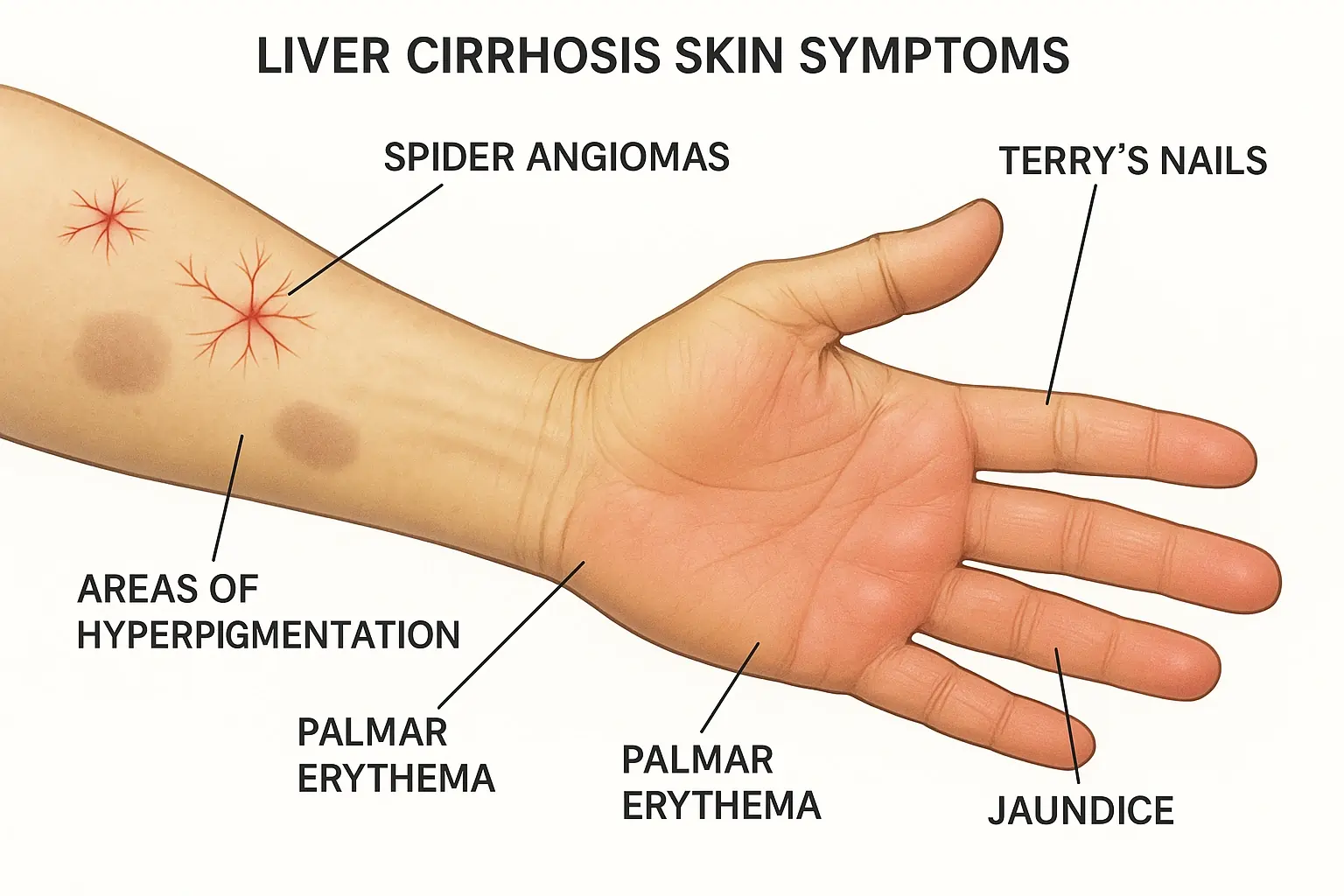
The Most Visible Warning Sign: Spider Angiomas
Let me start with something visible that often gets missed: spider angiomas, also called spider nevi.
These are small, dilated blood vessels that appear on your skin. They have a red center point with tiny capillaries radiating outward like spider legs. About 33 percent of people with liver cirrhosis develop these marks, and they're a classic sign doctors look for when evaluating cirrhosis of liver skin rash symptoms.
Where They Appear
You'll typically find spider angiomas on your face, neck, upper chest, or upper back. They're usually small, maybe the size of a pinhead to a pencil tip. But the key thing is that they often appear in clusters.
Why This Matters
Many people dismiss spider angiomas as birthmarks or harmless skin growths. Doctors who specialize in skin conditions might not connect them to liver disease. But here's what you need to know: if you have multiple spider angiomas in cirrhosis, especially if they're appearing for the first time in adulthood, they strongly suggest liver problems.
A single one might mean nothing. Multiple ones mean your body is sending a message about signs of liver failure skin and liver problem symptoms on skin that need attention.
The "Liver Palms" That People Ignore: Palmar Erythema
This symptom deserves special attention because it's so commonly overlooked in discussions about liver skin conditions and liver problems and skin issues.
Palmar erythema means your palms turn an unusual shade of red. This isn't a sunburn or an allergic reaction. The redness is usually symmetrical; both palms look the same and it often comes with a warm or burning sensation. This is one of the most obvious signs of what's sometimes called liver failure.
The Numbers Are Striking
About 66 percent of people with liver cirrhosis develop palmar erythema. That's two out of every three patients. This is one of the most common skin issues liver disease presents with, yet many people don't take it seriously.
Why Doctors Miss It
Palmar erythema can have other causes: pregnancy, rheumatoid arthritis, hyperthyroidism, or just genetics. So doctors sometimes dismiss it. But here's what makes it significant in liver problems: itching and other cirrhosis manifestations: it appears symmetrically, worsens with stress or heat, and is often accompanied by other liver problem skin rash symptoms.
The mechanism involves both hormonal imbalance and changes in how your body controls blood vessel function. Your cirrhotic liver can't regulate blood flow properly, so extra blood flows to your hands, creating visible redness related to can liver damage cause itching questions patients ask.
The Jaundice That Hides In Plain Sight
Jaundice is the yellowing of your skin, eyes, and mucous membranes. It happens when bilirubin, a yellow pigment from broken-down red blood cells builds up in your blood instead of being processed and eliminated. This is a key skin condition liver disease patients experience.
Everyone knows about jaundice. It's in every medical textbook. But here's what most people don't realize: jaundice is dramatically harder to detect in people with darker skin tones.
The Health Equity Problem
On pale skin, jaundice is obvious. The yellowing stands out immediately. On darker skin, the yellow tint is much more subtle. It might look like a slight change in tone that people attribute to tanning or natural skin variation. This means patients with darker skin often get diagnosed weeks or months later than patients with pale skin.
I've seen this happen repeatedly in my practice as a liver transplant surgeon in Delhi. A patient with darker skin comes in with advanced cirrhosis because the jaundice warning sign was invisible. A patient with pale skin catches the disease earlier because the yellowing was obvious.
This creates a health justice issue that the medical community doesn't talk about enough. If you have darker skin and you're watching for symptoms and signs of liver cirrhosis, pay special attention to the whites of your eyes and the inside of your mouth. These areas show cirrhosis liver jaundice more clearly than palms.
The Symptom That Destroys Quality Of Life: Pruritus
Here's something surprising: the most distressing skin symptom of cirrhosis isn't always the most visible one.
Pruritus is intense, persistent itching. About 25 to 50 percent of cirrhosis patients experience it. But the real issue is how severe it becomes and how much it affects daily life. Patients describe it as maddening. It keeps them awake at night. It makes them want to scratch their skin until it bleeds.
This addresses one of the most common questions: can liver problems cause itching and does liver problems cause itching? The answer is yes, and it's more common than most people realize.
Why Ordinary Treatments Don't Work
When people itch, they usually reach for antihistamines or cortisone cream. Neither works for liver disease pruritus. Why? Because the mechanism is different. The itching isn't from an allergy or inflammation. It's from bile salts accumulating in your skin. This is why a burning sensation in the liver develops and why can liver damage cause itching is such an important question.
Your liver produces bile to help digest fat. Normally, bile flows into your intestines. In cirrhosis, this bile backs up. Bile salts deposit in your skin tissue and trigger an inflammatory response. This is why standard anti-itch treatments fail. You're treating the wrong cause, and this connects to early liver disease and itchy skin symptoms.
The Pattern Matters
Cirrhosis-related itching often starts in your palms and soles. It tends to worsen at night and with heat. It doesn't respond to moisturizing or typical skin creams. If you have persistent itching that fits this pattern and it accompanies other symptoms I'm describing, this is a red flag for liver and skin itching issues.
Nail Changes: The Hidden Diagnostic Clue
Your fingernails tell stories about your health. In cirrhosis, nails change in ways that most people miss.
About 68 percent of people with chronic liver disease develop some form of nail abnormality. Understanding liver disease nail changes is important because your nails can be the first place doctors notice signs of liver failure skin.
Terry's Nails
These are nails with white or pale nail beds and a thin, dark band at the tip. The medical term describes a specific appearance: the nail becomes white and opaque except for a narrow pink or brown band at the tip. This happens because proteins in your blood drop too low in cirrhosis. Your nails lose their color due to this protein deficiency.
Muehrcke's Lines
These are horizontal white bands that run across your nails. Unlike Terry's nails, these lines don't involve the pink tissue at the tip. They run completely across the nail bed. The bands appear and disappear as your liver function improves or worsens. Medical researchers use Muehrcke's lines to assess how severe someone's liver failure, skin itching and related symptoms are.
Finger Clubbing
This is one that most people and most websites don't discuss in depth. Finger clubbing means the tips of your fingers become thick and swollen. Your nails curve downward more than normal. The area under your nails becomes boggy and spongy.
Why does this happen? Your cirrhotic liver isn't delivering enough oxygen to your tissues. Your body responds by thickening the finger tissue to try to extract more oxygen. It's a compensation mechanism that indicates early stage liver rash development.
Finger clubbing matters because it suggests your cirrhosis is advanced. It also needs to be distinguished from clubbing caused by lung disease. When I see a patient with clubbing, I know I need to investigate their liver carefully as a best liver transplant surgeon in Delhi.
The Rare But Critical Symptoms That Almost Nobody Mentions
Now I want to discuss symptoms that other websites and even many doctors overlook. These are important because they indicate more severe disease.
Dupuytren's Contracture: The Hand Deformity Nobody Talks About
About 25 to 28 percent of people with cirrhosis develop this condition. I rarely see it mentioned in patient education materials, yet it profoundly affects people's lives related to liver failure, hands appearance and function.
Dupuytren's contracture means the tissue under your palm the fascia starts to thicken and tighten. This creates cords of tissue that gradually pull your fingers inward. Eventually, your fingers curl and you can't straighten them. Your grip weakens. You lose hand function.
The mechanism is different from other liver problem symptoms on skin. It's not purely hormonal or vascular. It's a structural change in the tissue itself. The exact reason cirrhosis causes this isn't completely understood, but it's more common in alcoholic cirrhosis.
Here's why this matters: Dupuytren's contracture can be so severe that it requires surgical intervention. If caught early, treatments like hand stretching and injections can help. But if allowed to progress, surgery becomes necessary. This is a symptom that deserves medical attention and monitoring from a liver surgeon in Delhi or your local best liver doctor in Delhi.
Caput Medusae: The Snake-Like Veins
I'm going to describe something visually dramatic that almost no website mentions.
Caput medusae is a Latin term meaning "Medusa's head." It refers to enlarged, tortuous veins around your belly button that look like snakes radiating outward.
What causes this? Your cirrhotic liver creates extreme pressure in your portal vein. Your body finds alternative routes for blood. One of those routes is through veins around your umbilicus the belly button. These veins, which normally close before birth, reopen. The blood flowing through them creates visible, engorged, snake-like veins on your abdomen.
Why is this important? Caput medusae indicates severe portal hypertension. It means your cirrhosis is advanced. These veins are fragile and can bleed, causing life-threatening bleeding inside your abdomen.
If you develop visible, engorged veins around your belly button or across your abdomen, this is an emergency sign. Seek medical attention immediately from the nearest liver doctor Delhi or liver transplant surgeon facility.
Hair Loss and Hormonal Feminization: The Symptom Men Are Embarrassed to Discuss
Here's a symptom that gets mentioned in medical literature but almost never in patient materials: hormonal changes that affect sexual characteristics. This is rarely covered in discussions about liver skin rash or general skin rash and liver disease topics.
In male cirrhosis patients, the hormonal imbalance causes striking changes. About 84 percent of men with cirrhosis lose significant axillary underarm hair. About 96.55 percent develop gynecomastia, which is enlargement of breast tissue. Many men experience testicular shrinkage and loss of libido.
These changes are profoundly distressing. Men feel embarrassed discussing them. But they're important clinical signs that deserve attention and treatment as part of early stage hepatitis skin rash recognition and broader liver problem symptoms on skin understanding.
Female cirrhosis patients experience different hormonal effects: irregular or absent menstrual periods, breast tissue atrophy, and loss of sexual function. These changes also deserve acknowledgement and medical management.
The psychological impact of these visible hormonal changes is substantial and often overlooked by medical professionals focused only on the physical disease.
Putting It Together: The Progression Timeline
Let me help you understand how these liver skin rash symptoms and skin itching in liver disease typically appear over time.
Early Stage
In the early stages, you might notice one or two symptoms in isolation. A small spider angioma appears on your chest. You notice your palms look slightly red. You develop a bit of itching related to liver problem itching. Many people ignore these signals because they're subtle.
Intermediate Stage
Multiple spider angiomas become visible. Palmar erythema becomes more pronounced. Itching worsens and starts affecting sleep. Nail changes become apparent. You might notice your palms and soles itching more than other areas related to skin itching liver experiences. Hair loss becomes noticeable.
Advanced Stage
Multiple symptoms appear together. Severe itching dominates discussions of liver failure and itching. You see obvious nail abnormalities. Your skin darkens in patches. You develop visible ascites swelling in your abdomen from fluid buildup. You might notice Dupuytren's contracture starting, with palms becoming thick and fingers starting to curl. In some cases, caput medusae become visible as paper money skin or other dramatic vascular signs.
Critical Stage
These are emergency signs: sudden jaundice appearing or worsening rapidly, vomiting blood, black tarry stools, acute confusion, high fever, or rapid development of severe abdominal swelling.
When You Need To Act: Seeking Medical Help
I want to be very clear about this: not every skin symptom means you have cirrhosis. But if you're noticing multiple symptoms from this article, especially if they're appearing together, you need medical evaluation.
Schedule a Regular Appointment If You Notice:
You've developed new spider angiomas on your body. Your palms have turned persistently red indicating liver failure face changes. You're experiencing liver problem itchy skin that doesn't respond to normal treatments. Your nails are changing appearance. You're noticing hair loss or hormonal changes that seem unusual.
Seek Urgent Care If:
You suddenly develop jaundice that's worsening. You're noticing rapid development of abdominal swelling. You develop visible veins radiating from your belly button.
Go to the Emergency Room Immediately If:
You're vomiting blood or material that looks like coffee grounds. You're having black, tarry stools. You're experiencing acute confusion or difficulty staying alert. You develop high fever if you already have a cirrhosis diagnosis. You suddenly become jaundiced along with other symptoms.
The Diagnostic Path Forward
If you present with these skin signs, here's what doctors typically do next.
As a liver transplant surgeon, I'll order liver function tests to measure bilirubin, albumin, and liver enzymes. We'll check your prothrombin time to assess your liver's ability to produce clotting factors. We'll likely perform an ultrasound to visualize your liver and check for signs of cirrhosis and portal hypertension.
The skin signs themselves are valuable diagnostic clues. We use them alongside blood tests and imaging to confirm cirrhosis and assess its severity. Multiple skin signs appearing together make the diagnosis more likely than single isolated symptoms. This is why recognizing signs of liver failure skin is critical.
What Happens Next: Management And Reversibility
Here's important news: some symptoms improve with treatment, while others require ongoing management.
Jaundice can improve when the underlying cause is treated. Pruritus related to liver and skin rash can be managed with medications like ursodeoxycholic acid or medications that block bile acid receptors. Some nail changes slowly improve as your liver function stabilizes. Skin care with gentle cleansers and hypoallergenic moisturizers helps with liver skin itching and dryness.
But other changes may be permanent. Advanced Dupuytren's contracture may require surgery. Caput medusae indicates advanced disease where transplant evaluation becomes necessary. Hormonal changes partially reverse but may not completely normalize.
This is why early detection matters. When we catch cirrhosis early through recognizing liver problem rashes and other skin liver cirrhosis signs, we have more treatment options. We can address the underlying cause whether that's stopping alcohol, treating hepatitis, or managing fatty liver disease.
Special Situations And Considerations
I want to address a few specific populations that need special attention.
If you have darker skin, be extra vigilant about checking for jaundice in your eyes and mouth. The yellowing may be subtle on your skin but clear in your sclera and oral mucosa. Don't wait for obvious skin yellowing if other early stage liver rash symptoms are present.
If you're female with cirrhosis, your menstrual changes, breast changes, and hormonal symptoms deserve medical attention just as much as visible liver skin conditions do. Don't dismiss these as unrelated to your liver disease.
If you have a history of heavy alcohol use, viral hepatitis, or metabolic conditions like fatty liver disease, be especially watchful for these liver problem symptoms on skin. Your risk for cirrhosis is higher.
The Role Of A Liver Specialist
If you're developing these symptoms, you need evaluation by someone who specializes in liver disease. As a liver transplant surgeon in Delhi, I've built my practice on recognizing these early signs and intervening before cirrhosis becomes life-threatening.
A best liver transplant surgeon in Delhi or liver doctor Delhi can differentiate between symptoms caused by cirrhosis versus other conditions. We can assess your disease stage and recommend appropriate treatment. We can monitor you over time to catch complications early.
If your cirrhosis advances to a point where transplant becomes necessary, a liver surgeons specialist can evaluate whether you're a candidate for liver transplantation, a procedure that can transform lives and extend survival substantially.
Final Words: Your Skin Is Talking—Listen To It
Your skin is trying to tell you something. When you notice spider angiomas appearing, palms turning red, itching becoming severe, nails changing shape, or any of the other symptoms and signs of liver cirrhosis I've described, your body is sending a message about your liver.
The patients who do best are those who recognize these signs early. They seek medical evaluation. They get diagnosed before a crisis happens. They have treatment options available that people diagnosed in emergencies don't have.
Meera, from the beginning of this article, eventually received a liver transplant. She survived. But she spent months in critical condition and had complications that might have been prevented with earlier diagnosis.
You don't have to be Meera. You can be someone who recognizes these skin itching and liver symptoms, acts on them, and gets ahead of liver disease.
If you're noticing multiple symptoms described in this article, especially if they're appearing together, don't wait. Schedule an appointment with your primary care doctor or ask for a referral to a best liver doctor in Delhi or your local liver specialist. The best liver transplant surgeon in Delhi or your regional liver transplant surgeon can evaluate you properly.
Your skin has been sending signals all along. Now you know what to listen for.
Are you noticing skin changes that concern you? Have you been experiencing persistent liver problems, itchy skin or other symptoms described here? Don't wait for an emergency to act.
If you're in Delhi or nearby areas and want expert evaluation of potential liver disease signs, Dr. Ashish George and his team specialize in comprehensive liver assessment and treatment. As a best liver transplant surgeon in Delhi and experienced liver doctor Delhi, we provide comprehensive care for patients showing early stage hepatitis skin rash, liver skin rash photos, or any liver problem symptoms on skin.
Contact a liver transplant surgeon in Delhi or liver surgeons near you to get properly evaluated. Your liver health matters. Your life depends on catching cirrhosis early. Take that first step today.