Liver Disease Screening: When Should You Get Tested and Which Tests Matter Most?
.webp)
Principal Consultant & Unit Head, Liver Transplant & HPB Surgery, Fortis Hospital, Shalimar Bagh, Delhi
The Liver Stays Silent Until the Damage Is Done
In my years as a liver transplant surgeon, one pattern repeats itself more than any other. Patients walk into my clinic not because they felt something was wrong, but because a routine check accidentally revealed a liver in serious trouble. The liver is a forgiving organ. It continues functioning through years of quiet injury, compensating so well that most people have no idea anything is wrong until the disease has already advanced.
This is not a rare occurrence. Fatty liver disease, hepatitis B and C, cirrhosis, and liver cancer collectively affect millions of people in India, and a large proportion of them are undiagnosed. What makes this particularly concerning is that early-stage liver disease is often very manageable. The challenge is simply finding it in time.
Liver screening exists to close that gap. A few targeted tests, done at the right intervals, can detect problems years before symptoms appear and years before options narrow. This guide will walk you through who needs screening, which liver tests are worth doing, how often to repeat them, and what to do if something turns up.
Who Actually Needs Liver Screening?
The short answer is: more people than currently get it. Liver disease is not confined to those who drink heavily or have a known infection. Several common, everyday health conditions quietly accelerate liver damage over time.
I routinely recommend a baseline liver function test and screening workup for anyone who falls into one or more of the following categories:
- People with fatty liver disease, whether confirmed by a previous ultrasound or suspected based on weight and metabolic history
- Those with type 2 diabetes or prediabetes, since insulin resistance is one of the primary drivers of liver fat accumulation
- Individuals who are overweight or obese, particularly with a BMI at or above 23 by Asian standards
- Anyone who drinks alcohol regularly, even at socially acceptable levels, since liver damage from alcohol is cumulative and often underestimated
- People living with chronic hepatitis B or C, both of which are leading causes of cirrhosis and liver cancer
- Those with a close family member who has been diagnosed with liver disease, cirrhosis, or liver cancer
- Patients on long-term medications such as anti-tuberculosis drugs, methotrexate, or high-dose painkillers, all of which place ongoing stress on liver cells
- Anyone with persistently high cholesterol or triglycerides, as this metabolic pattern frequently overlaps with fatty liver disease
Age-based guidance: Adults over 35 with no specific risk factors should still include a basic liver panel in their annual health check. If any of the above apply to you, screening should begin earlier, typically in your late twenties or early thirties.
One thing I want patients to understand clearly: you do not need to feel unwell to have significant liver disease. I have seen patients with advanced fibrosis who felt completely normal right up to the point of diagnosis. Proactive screening is not about fear. It is about catching a problem while it is still solvable.
Symptoms That Often Get Ignored
The liver rarely raises an alarm, but it does send signals. The problem is that these signals are easy to attribute to something else entirely.
Watch out for persistent fatigue that does not improve with rest. A vague heaviness or mild discomfort in the upper right side of the abdomen is another sign worth paying attention to. Nausea that tends to follow rich or fatty meals is often dismissed as indigestion, but it can reflect a struggling liver. Slight yellowing of the whites of the eyes, even in very mild form, should always be investigated promptly since it suggests rising bilirubin levels.
Urine that has turned dark, taking on a tea-like or cola colour, is a warning sign that cannot be brushed aside. Skin that itches persistently without any visible rash can indicate bile salt buildup beneath the skin surface. Unexplained loss of appetite, gradual weight loss without any dietary change, and a tendency to bruise or bleed more easily than usual are all signs that the liver may not be producing adequate clotting factors.
If two or more of these are present at the same time, please do not delay getting a liver test.
The Tests That Matter and What They Actually Measure
Liver Function Test (LFT)
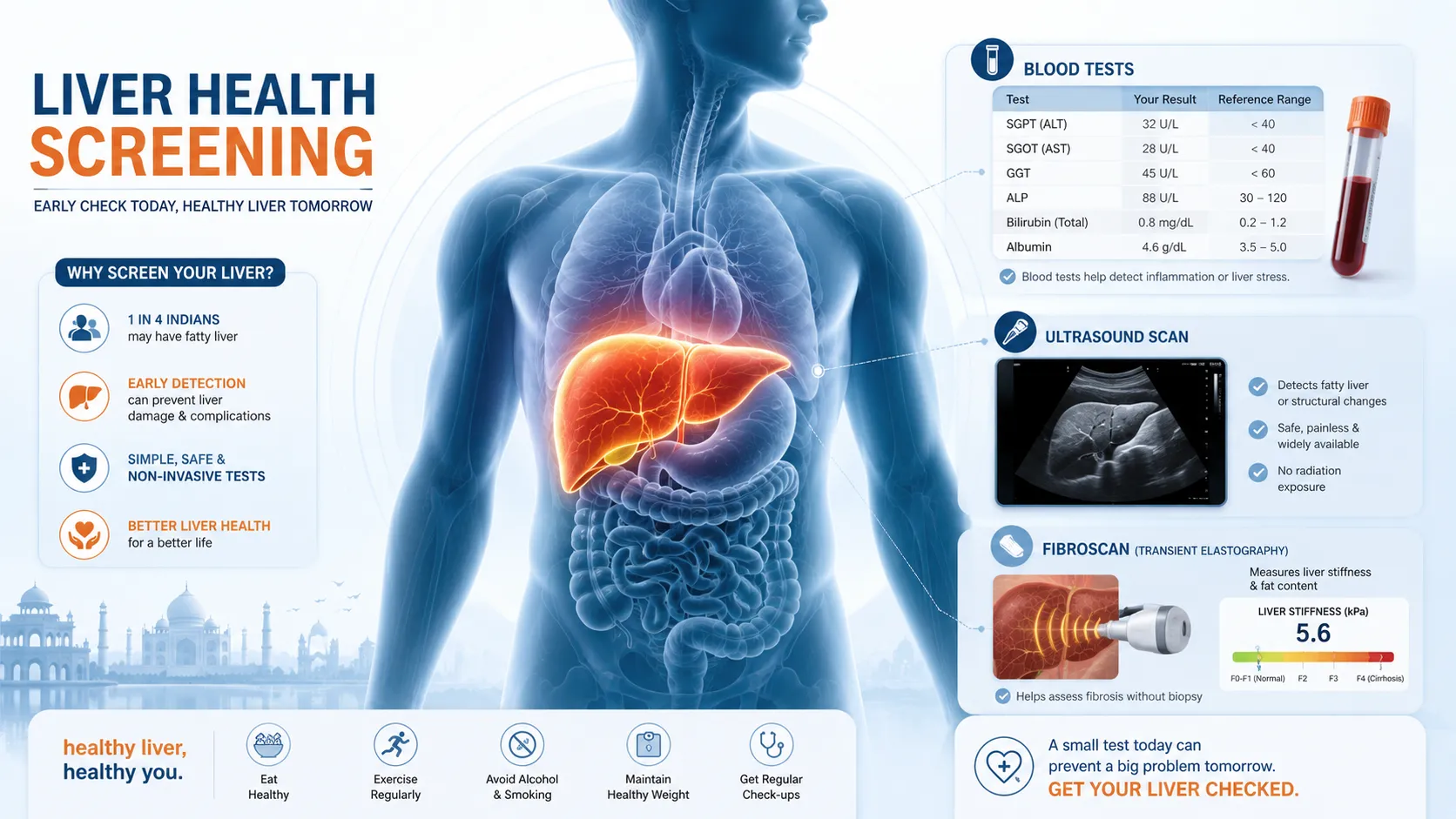
The liver function test is where all screening begins. It is a blood test that measures a set of enzymes and proteins: ALT, AST, ALP, bilirubin, albumin, and total protein. Among these, ALT is particularly sensitive to liver cell damage and is often the first value to rise when something is wrong.
The LFT is affordable, available at virtually every diagnostic lab, and requires no special preparation. It should be part of every adult's annual blood work, especially if any risk factors are present.
Ultrasound and FibroScan
An abdominal ultrasound gives the doctor a structural view of the liver, showing its size, surface texture, and any visible abnormalities such as cysts, nodules, or signs of fat infiltration. It is a non-invasive and widely accessible test.
FibroScan, also called transient elastography, takes the assessment a step further. It uses a gentle ultrasound-based vibration to measure how stiff the liver is. Stiffness in liver tissue corresponds directly with the degree of fibrosis or scarring present. This is a particularly valuable tool for anyone with fatty liver disease or chronic hepatitis, since it can detect scarring at an early stage, well before symptoms develop. The procedure takes about ten minutes and causes no discomfort.
Anyone with elevated liver enzymes or a known diagnosis of fatty liver disease should have both tests done together.
CT Scan and MRI
These imaging tools are not used for routine screening. They come into the picture when something specific needs to be investigated further, such as a lesion detected on ultrasound, suspected advanced cirrhosis, or pre-surgical planning. MRI with contrast is especially useful for soft tissue characterisation and carries no radiation risk. CT with contrast remains the preferred tool for evaluating liver tumors and planning surgical resections.
Liver Biopsy
A liver biopsy involves taking a small tissue sample from the liver using a fine needle, which is then analysed under a microscope. It remains the most accurate method for determining the exact grade of fibrosis and for confirming diagnoses such as autoimmune hepatitis or advanced NASH. It is not a screening tool and is generally reserved for cases where the result will directly change the treatment approach.
How Often Should Each Group Get Tested?
What to Do When Results Come Back Abnormal
An abnormal liver test is a starting point for investigation, not a final verdict. How seriously to take it depends on the degree of elevation and the clinical context.
When liver enzymes are mildly elevated, between one and three times the normal range, this often points toward fatty liver or a medication-related effect. The appropriate response is a period of lifestyle modification, a repeat blood test in about three months, and an ultrasound to assess liver structure.
When enzymes are significantly elevated, more than three times the normal range, the workup needs to move quickly. This usually means testing for viral hepatitis, checking autoimmune markers, and obtaining imaging, ideally within days rather than weeks.
A FibroScan result showing advanced fibrosis at stage F3 or F4 requires specialist input without delay. At this level of scarring, the right treatment can genuinely halt further progression and, in some cases, partially reverse the damage. Time matters considerably at this stage.
One important point: please do not attempt to interpret your own lab results based on reference ranges printed on the report. The same enzyme level can carry very different significance depending on your age, body weight, medications, and overall health picture. Results always need to be reviewed by a physician who knows your full history.
Prevention Steps That Are Genuinely Effective
Rethink your diet. Cutting down on refined sugar, fried foods, and highly processed items reduces the metabolic load on the liver considerably. A diet rich in vegetables, legumes, whole grains, and lean protein supports liver repair and reduces fat accumulation. Research consistently supports the Mediterranean-style eating pattern as beneficial for liver health.
Be honest about alcohol. There is no threshold of alcohol intake that is without risk to the liver. If you drink, keeping consumption below two standard units per day with several alcohol-free days each week reduces harm significantly. If you already have liver disease of any kind, the recommendation is complete abstinence.
Work toward a healthier weight gradually. A sustained reduction of seven to ten percent of body weight has been shown in multiple studies to meaningfully reduce liver fat and inflammation. Rapid weight loss, paradoxically, can sometimes worsen liver inflammation, so a slow and consistent approach is far better.
Review your medications with your doctor every year. Paracetamol at high doses, many herbal and Ayurvedic preparations, and anti-tuberculosis drugs all carry hepatotoxic potential. Your doctor needs a complete list of everything you take.
Get vaccinated against hepatitis B. If you have not completed the three-dose hepatitis B vaccine series, please do so. It is one of the most effective cancer-prevention measures available and is underutilised in adults.
Move more. 150 minutes of moderate physical activity per week has been shown to reduce liver fat directly, separate from any effect on body weight. A brisk daily walk qualifies.
When a Specialist Consultation Becomes Necessary
Your family physician or general practitioner is the right first contact for most liver-related concerns. However, there are specific situations where a hepatologist or liver surgeon needs to be involved directly.
These include liver enzymes that remain elevated despite three months of lifestyle changes, a FibroScan result showing fibrosis at F2 or above, any liver lesion or nodule identified on imaging, the need to make treatment decisions regarding chronic hepatitis B or C, and the development of more advanced symptoms such as jaundice, fluid accumulation in the abdomen, episodes of confusion, or any bleeding from the upper digestive tract. A family diagnosis of liver cancer or an inherited liver disorder is also a valid reason to seek specialist input proactively.
Book a Liver Consultation
If you have been putting off a liver check, or if any of the risk factors above apply to you, consider this a prompt to act. A straightforward blood test and ultrasound take less than a morning and can tell you a great deal about where your liver health stands. Caught early, most liver conditions are manageable. Caught late, the options become far more limited.
[Book Your Consultation]
Frequently Asked Questions
What is the best liver test to start with? Start with a Liver Function Test (LFT) - it is a simple blood test available at any diagnostic lab. Abnormal values will guide your doctor toward the next step, usually an ultrasound or FibroScan. These three together cover the basics well.
Can fatty liver be reversed once detected? Yes, and this is genuinely good news. Fatty liver caught before scarring sets in responds well to weight loss, dietary changes, and regular exercise. Many patients see significant improvement within three to six months of consistent effort.
Do elevated liver enzymes always mean something serious? Not always - a single elevated reading can follow intense exercise, a viral infection, or a new medication. That said, two consecutive abnormal results should never be brushed aside. Always repeat the test and have a doctor review the trend, not just the number.
How is FibroScan different from a standard abdominal ultrasound? An ultrasound shows what the liver looks like; a FibroScan measures how stiff it is, which reflects the degree of internal scarring. They complement each other rather than replace one another. If your ultrasound shows fatty changes, a FibroScan is the logical next step.
At what age should liver screening become a regular habit? Age 35 is a sensible starting point for anyone without known risk factors. If you have diabetes, carry extra weight, or drink regularly, start in your late twenties. A quick conversation with your doctor will help you decide the right schedule for your situation.